The IMF’s warning lands amid what TD Economics called a deepening productivity crisis

Canada’s patchwork of internal trade rules moved from academic talking point to urgent economic issue, with the International Monetary Fund warning that fragmented provincial markets weigh on growth, productivity and ultimately housing supply.
In a new country focus, IMF economists Federico Díez and Yuanchen Yang said “goods, services, and workers face significant barriers when moving across provincial and territorial lines—a fragmentation that affects productivity, competitiveness, and overall resilience.”
They estimated non‑geographic, policy‑related barriers at about a 9% tariff nationally, with some service sectors facing the equivalent of a 40% tariff.
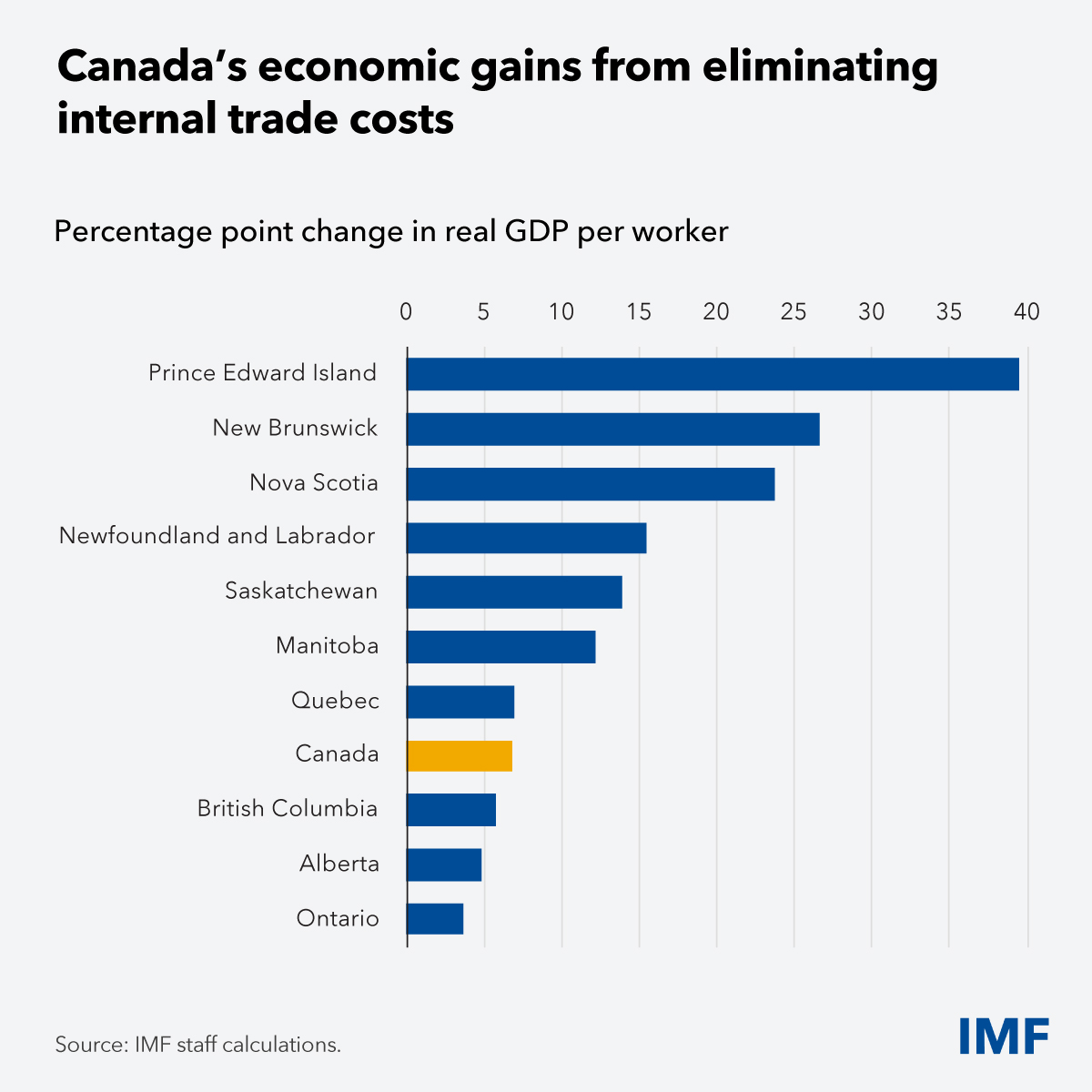
“Fully eliminating non‑geographic internal trade barriers could raise Canada’s real GDP by nearly 7 percent over the long run—roughly C$210 billion in today’s terms,” the authors said, stressing that gains would come from “more efficient allocation of capital and labor, stronger competition, and better scale for high‑performing firms.”
Smaller and remote regions stand to gain most in percentage terms, with the IMF highlighting Atlantic Canada and the northern territories as potential productivity winners.
Services at the centre of the housing story
The IMF said “roughly four‑fifths of the total GDP gains would come from liberalizing services sectors” such as finance, telecommunications, transportation and professional services, which act as critical inputs across the economy.
Those sectors also sit upstream of residential construction and mortgage distribution, where financing, insurance, design and permitting services shape how quickly and cheaply new projects moved.
“Canada isn’t really one economy. It’s really 10 economies,” said Alicia Planincic, director of policy and economics at the Business Council of Alberta, pointing to regulatory frictions that made it harder for workers to move and for firms to expand across borders.
Canada Mortgage and Housing Corporation previously indicated that easing internal barriers could “lead to an additional 30,000 housing starts annually,” pushing total starts toward 280,000 and lifting household incomes by around 6% over time, with more renters able to shift into ownership.
Link to a broader productivity and affordability crunch
The IMF’s warning lands amid what TD Economics called a deepening productivity crisis, with investment per worker near the bottom of the OECD and tax and regulatory complexity weighing on scale.
CMHC recently estimated that weak productivity in residential construction alone added “$6 billion to $8 billion” in costs since 2019, accounting for up to 20% of new‑home price increases.
In a separate assessment, the IMF said housing affordability “reached its worst levels in a generation,” as supply failed to keep pace with population growth.
If provinces used cooperative federalism, mutual recognition and targeted deregulation to “turn thirteen economies into one,” the IMF said, internal integration could become “one of the most powerful—and least fiscally costly—levers to raise productivity, strengthen resilience, and support inclusive growth.”
Make sure to get all the latest news to your inbox on Canada’s mortgage and housing markets by signing up for our free daily newsletter here.