New polling showed cost-of-living anger outpaced praise for foreign policy wins

Affordability frustration, not geopolitical anxiety, appeared to be shaping Canadian sentiment a year into prime minister Mark Carney’s minority government.
New data from the Angus Reid Institute found that while Canadians approved of the government’s performance on foreign policy and defence, they believed it fell short where it mattered most to their pocketbooks.
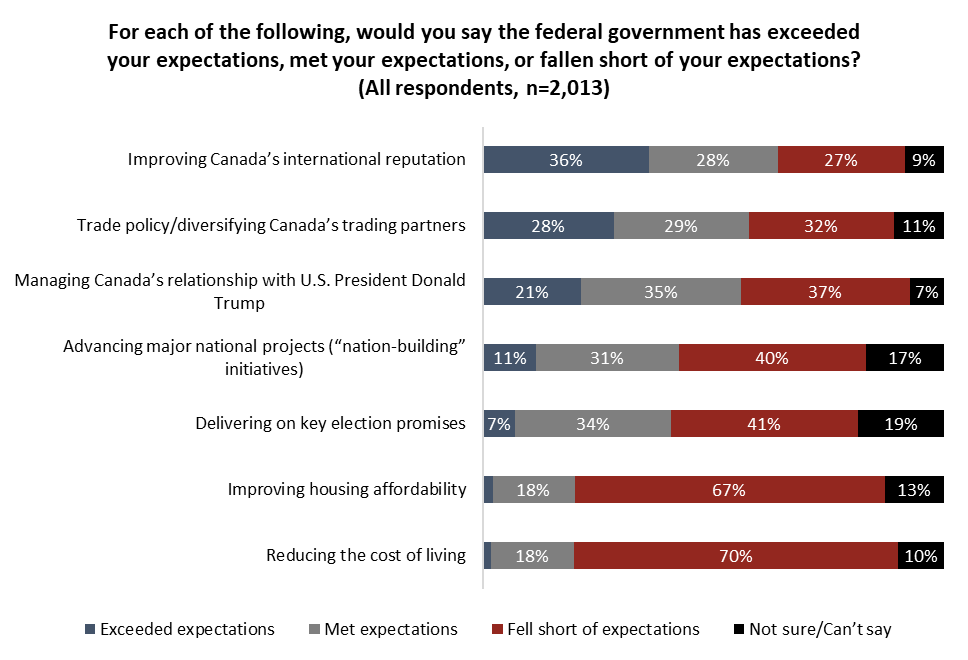
A majority said the Carney government met or exceeded expectations on improving Canada’s international reputation at 64%, diversifying trade partners at 57% and managing the relationship with the United States at 56%.
On the other hand, “more than two-thirds say Carney’s government has fell short on addressing housing affordability (67%) and the high cost of living (70%),” the institute reported.
According to Ratehub.ca’s latest home affordability report, ten cities saw affordability worsen, two cities saw improvement, and one saw no change.
Halifax and Victoria led the deterioration. Halifax’s benchmark price climbed to $571,700 in March, up $13,100 from February, adding $61 to the typical monthly payment.
Affordability pressure remains core concern
Half of respondents, at 52%, identified reducing the cost of living as the federal government’s biggest challenge over the next year, compared with 31% who pointed to managing the US relationship with president Donald Trump.
One year earlier, 53% of Canadians cited the high cost of living as the top national issue, ahead of health care at 38%, US relations at 27%, housing affordability at 26% and the broader economy at 25%.
The latest poll showed worries over the cost of living rising to 59% and health care to 41%, while ethics and corruption and jobs also gained prominence.
Housing and inflation set the backdrop
Canadians were evenly split on whether the minority government met its own election promises, with 41% saying expectations were met and 41% saying they were not.
Carney’s Liberals campaigned on creating “the most ambitious housing plan since the Second World War” that they said would double residential construction over the next decade.
However, the annual rate of housing starts fell 6% to 235,852 units in March, compared with 250,961 in February, according to Canada Mortgage and Housing Corporation (CMHC).
According to Canada Mortgage and Housing Corporation (CMHC), the seasonally adjusted annual rate (SAAR) of housing starts fell 6% to 235,852 units compared with 250,961 in February.https://t.co/E6K9wh5pHN
— Canadian Mortgage Professional Magazine (@CMPmagazine) April 17, 2026
Meanwhile, headline consumer prices ticked up to about 2.4% in March as gasoline costs jumped, but underlying pressures stayed contained and well within the Bank of Canada’s 1–3% target band.
Brokers increasingly view inflation, rate-hike aftershocks and record debt-service ratios as the key threats to first-time buyers and renewing borrowers, rather than pure credit risk.
That professional sentiment lined up with political findings showing more Canadians, at 42%, felt the country is on the wrong track than the right one at 34%. Majorities across most party lines believe the government has fallen short on the cost of living.
The Angus Reid Institute online survey was conducted among 2,013 Canadian adults from April 15 to 20, 2026.
Make sure to get all the latest news to your inbox on Canada’s mortgage and housing markets by signing up for our free daily newsletter here.