
Record-low ground-oriented starts left Ontario further from its housing pledge

Ontario’s January housing figures appeared encouraging at first glance, with starts up nearly 12% year over year. Yet behind that headline, new analysis from economist Mike Moffatt and the University of Ottawa’s Missing Middle Initiative (MMI) suggested the province’s family-sized housing stock was moving in the wrong direction.
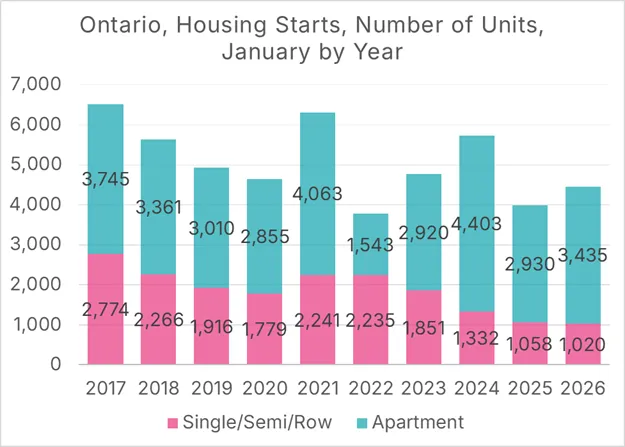
The province recorded 4,455 housing starts in January 2026, still below the 10‑year January average of 5,045, according to MMI’s breakdown of Canada Mortgage and Housing Corporation (CMHC) data.
Ground‑oriented homes – single‑detached, semis and rows – fell to just 1,020 units, the lowest January on record since 1990. Annualized, total starts sat under 54,000, roughly 30% of Ontario’s 175,000‑unit annual goal.
“Graphing this month’s figures against those of the previous nine Januarys illustrates the relatively modest nature of this increase,” Moffatt said.
He added that Ontario needed to be “clear‑eyed about how far away” it remained from its 1.5‑million‑homes‑in‑10‑years commitment.
MMI’s analysis showed housing starts declined each year since 2022, with just 65,000 units started in 2025, and forecast further weakness across most of Canada.
“There is a common belief that Canada’s new housing weakness is simply a problem in Vancouver and Toronto,” Moffatt said.
In percentage terms, mid‑sized centres such as Guelph, Barrie, Peterborough and Oshawa saw steeper declines in starts than the Toronto CMA, he noted.
Family housing squeezed as rentals take the strain
Simply counting units risks understating the problem, Moffatt argued. “A housing unit can range from a studio condo to a four‑bedroom home,” he said. Ownership‑oriented construction – both condominium and freehold – has been “in freefall,” while purpose‑built rental remained the only leg of Ontario’s “new housing stool” still functioning.
CMHC’s supply‑gap work has repeatedly warned that Canada needed millions of additional homes by 2030 to restore affordability, with Ontario carrying the largest shortfall. Other forecasters, including TD Economics, have projected Ontario starts to hover near recent lows for the next several years as condo presales and single‑family preconstruction sales weakened.
Fresh TRREB data shows GTA home sales down 19.3% year over year in January, with average prices slipping 6.5% to $973,289 and condo transactions plunging 26%. https://t.co/jOxfW7y9Fv
— Canadian Mortgage Professional Magazine (@CMPmagazine) February 5, 2026
Cost-of-delivery crisis keeps new projects on ice
For Moffatt, the core issue lies on the cost side. “Ontario’s problem is simple: While the price of housing has fallen, the cost of building new homes has not, so new builds cannot compete with resale,” he said. That gap also threatened new rentals, with falling rents in some markets colliding with construction costs at “all‑time highs.”
He warned that without a sharp reduction in building costs, Ontario risks “a period of slow‑to‑no housing construction” followed by another price surge when demand revived.
Eliminating HST on new housing and implementing the wider package in his “Blueprint to Restore Homeownership for Young Canadians” would be “a good start,” he said, but only if governments treat the situation “as the crisis it is” and move to cut what he has elsewhere called an “alphabet soup” of fees on new homes.
Make sure to get all the latest news to your inbox on Canada’s mortgage and housing markets by signing up for our free daily newsletter here.


