February data showed a fragile rebound in Canadian homebuilding

Canadian housing starts posted a modest rebound in February, but economists and industry data pointed to a market still losing momentum beneath the surface.
The latest figures suggest builders are working through earlier project decisions while facing weaker demand, higher costs and a darker macro outlook.
Canada Mortgage and Housing Corporation (CMHC) reported that the seasonally adjusted annual rate of housing starts rose 4.5% month over month to 250,900 units in February. That's up from a revised 240,148 in January.
The six‑month trend – a moving average used to smooth volatility – inched up just 0.4% to 256,005 units, essentially flat.
Actual starts in centres with populations of 10,000 or more were up 10% year over year, with 15,886 units in February and a 5% gain year‑to‑date.
“In February, the six‑month trend in housing starts was essentially flat, indicating that the trend in new construction activity remains relatively steady despite ongoing monthly volatility,” said Kevin Hughes, CMHC’s deputy chief economist.
“Looking ahead, we expect heightened levels of business uncertainty and construction costs to weigh on the rate and trend of housing starts in the near‑to‑medium term.”
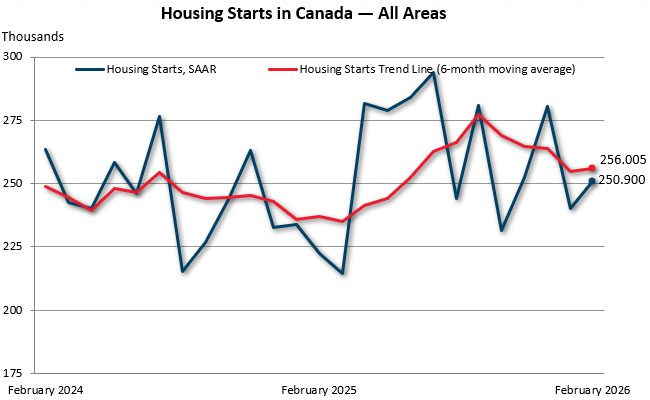
Trend stayed strong but momentum cooled
Economists underlined that February’s gain followed a sharp pullback. “The bounce‑back was tepid. So far in the first quarter, starts are down about 4% compared to their Q4 level, boosting the risk that starts act as a drag on residential investment in Q1 GDP growth,” Rishi Sondhi, economist at TD Economics, said.
Sondhi said the increase has been concentrated in the multi‑family sector, with urban multi‑family starts up 8% month over month to 192,300 units, while urban single‑detached starts fell 8% to 38,200 units.
He said the broader trend in starts have “generally [been] cooling since September of last year” and would likely keep easing amid “weak population growth, high costs, elevated levels of unsold inventories, and very weak pre‑sales activity in key markets like the GTA.”
While February’s numbers kept construction running at a historically solid level, leading indicators pointed in the opposite direction.
CMHC defined a housing start as the point when the footing of a foundation was poured. According to CIBC Capital Markets, that definition meant the data reflected project decisions made 12 to 18 months earlier. As a result, housing starts were a lagging indicator of overall market health.
Regional picture remained sharply divided
CMHC data showed an uneven landscape. Among Canada’s three largest centres, Montreal posted an 18% year‑over‑year increase in actual starts in February, and Vancouver recorded a 60% jump. Both were driven by stronger multi‑unit and single‑detached activity.
Toronto, by contrast, saw a 28% decline as both segments pulled back. Rural starts were estimated at an annualized 20,400 units.
TD Economics said February’s gains were led by Quebec and the Prairie provinces, with notable strength in Manitoba and Saskatchewan.
Starts in British Columbia dropped and remained flat at a low level in Ontario, reinforcing concerns raised in earlier TD work that the recovery in homebuilding and sales would be “gradual” and constrained by “elevated economic uncertainty, a subdued job market and a leveling off in interest rates.”
Make sure to get all the latest news to your inbox on Canada’s mortgage and housing markets by signing up for our free daily newsletter here.