All capital cities record gains as supply remains tight

National dwelling values increased by 0.6% in July, maintaining a consistent rate of growth for the third consecutive month, according to the latest Home Value Index from property analytics firm Cotality.
This marks the sixth month in a row of rising home values, a trend that began following the first interest rate cut in February. Growth has stabilised at just above half a percent each month since May, as limited housing supply, lower interest rates, and improved sentiment are offset by affordability challenges and ongoing uncertainty.
“At the national level, the pace of growth in housing values is no longer accelerating,” said Tim Lawless (pictured), research director at Cotality. “Rather, we have seen growth rates holding a little above half a percent from month to month since May as the opposing influence of low supply, falling interest rates and rising confidence run up against affordability constraints and lingering uncertainty.”
All capital cities saw increases in dwelling values during July. Darwin led with a 2.2% rise, followed by Perth at 0.9%. Hobart, Melbourne, and the ACT recorded more modest gains of 0.1%, 0.4%, and 0.5% respectively.
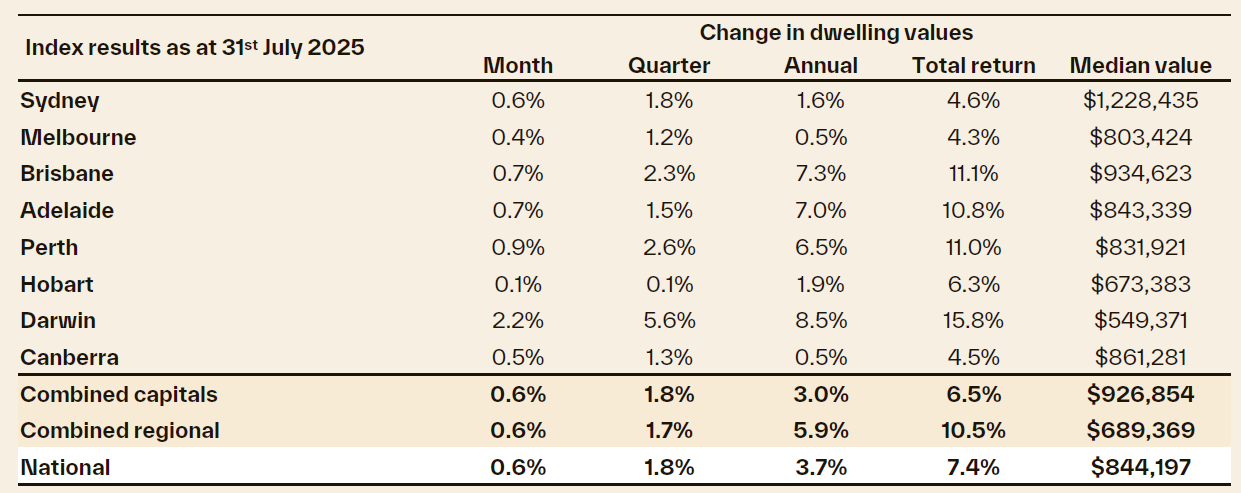
“While the Darwin trend doesn’t have much influence on the headline numbers, the Top End capital has moved into a solid upswing, posting a 9.7% gain through the first seven months of the year,” Lawless said. “The mid-sized capitals are also once again standing out, especially Perth, where the monthly pace of gains has accelerated to the fastest rate of growth since September last year.”
Persistently low inventory continues to underpin the positive trend, with national property listings 19% below the five-year average for this time of year. Cotality’s data also shows annual sales are tracking nearly 2% above the five-year average, supporting auction clearance rates that have remained slightly above the decade average since mid-May.
While monthly growth has stabilised, the rolling quarterly change indicates momentum is building. The national index rose 1.8% in the three months to July, the strongest quarterly result since June last year.
House values are once again rising faster than unit values. Over the past three months, national house values climbed 1.9%, adding about $16,700 to the median price. Unit values increased by 1.4%, or roughly $9,700. This divergence may reflect higher interest rate sensitivity in more expensive markets, where increased borrowing capacity typically favours detached houses during market upswings.
The gap between the national median house and unit values has reached a record 32.3%, or approximately $223,000.
“Such a wide difference comes amid ongoing affordability constraints and a lack of newly built multi-unit housing supply, which seems counter-intuitive,” Lawless said. “Clearly, demand preferences are still weighted towards detached housing options despite the substantially lower price points available across the unit sector.”
Regional markets are no longer outperforming the capitals, with combined regional values up 1.7% over the quarter, compared to 1.8% for the capitals. However, some regional areas in Victoria (1.4%), Queensland (2.5%), and South Australia (2.0%) continue to outpace their respective capital cities.
Want to be regularly updated with mortgage news and features? Get exclusive interviews, breaking news, and industry events in your inbox – subscribe to our FREE daily newsletter. You can also follow us on Facebook, X (formerly Twitter), and LinkedIn.