Industry says construction workforce gap threatens housing delivery targets

Australia’s labour market showed little sign of loosening in March 2026, according to Australian Bureau of Statistics (ABS) data, with the jobless rate holding at 4.3% even as full-time employment climbed.
The figures showed an increase of 52,500 full-time roles across the economy. Nearly 35,000 people moved from part-time to full-time hours over the month, contributing to the lift in full-time jobs.
Total number of employed people 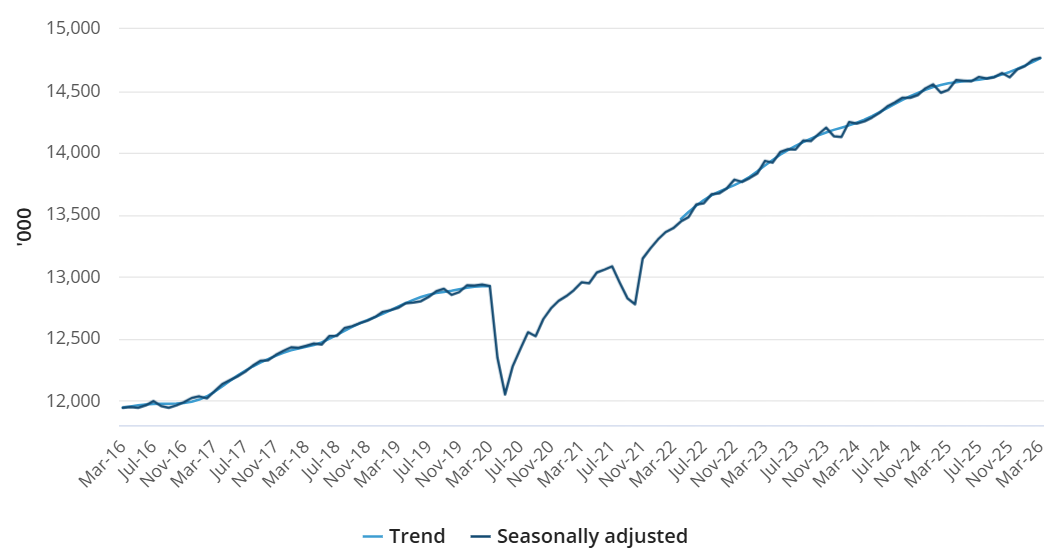 Source: Australian Bureau of Statistics
“The number of employed people rose by 18,000 and the number of unemployed people fell by 4,000 in March,” said Sean Crick, ABS head of labour statistics. “Growth in employment was driven by full-time workers, which rose by 53,000 people in March. This was partly offset by a fall in part-time employment of 35,000 people.”
Shane Garrett, chief economist at Master Builders Australia, noted that while March was dominated by the Middle East crisis, demand for labour was still very strong.
“As a result, large numbers of part-time workers switched to full-time hours. This pattern suggests that the number of new workers joining the labour force is currently too small,” he said.
 Master Builders Australia chief executive Denita Wawn (pictured right), however, said that the construction industry’s labour shortfall required a skilled migration pathway that could act as a bridge while domestic apprenticeship changes take effect.
“The current skilled migration system is fragmented, costly and suffers from slow skills recognition,” she said. “Trades remain significantly under-represented, and Australia is failing to utilise skilled migrants already in the country.”
She added that even with major changes to vocational education and training, the lag before additional apprentices and graduates become fully qualified tradespeople would be measured in years.
“If done right, an improved system could deliver 2.4 houses per skilled migrant, according to Activate Australia Skills, offsetting increased demand on housing and helping to reach construction targets including the National Housing Accord," said Denita Wawn, chief executive at Master Builders Australia.
In its pre-budget submission, Master Builders Australia set out a series of proposals aimed at sharpening immigration settings for construction. It called for construction to be treated as a national priority, with trades included in the “priority 1” skilled migration visa stream. It also sought an expansion of the Pacific Australia Labour Mobility (PALM) program to cover non-licensed construction jobs, backed by training and clearer routes to permanent employment.
The group also argued for faster skills recognition and licensing, including measures to mobilise an estimated 18,400 skilled permanent migrants already in Australia who are working below their capability. It proposed a dedicated Construction Skills Pathway visa to accelerate entry for qualified trades and technicians, along with lower employer costs by reducing or removing the Skilling Australia Fund levy, cutting fees, and introducing simpler sponsorship rules for small businesses. It also urged additional resources to clear temporary visa processing backlogs to meet current and emerging demand.
Want to be regularly updated with mortgage news and features? Get exclusive interviews, breaking news, and industry events in your inbox – subscribe to our FREE daily newsletter. You can also follow us on Facebook, X (formerly Twitter), and LinkedIn.