New Cotality figures point to faster gains below scheme caps, with Sydney showing the widest split

Homes valued below the expanded 5% deposit guarantee price caps rose 6.7% over the first six months of the scheme, compared with a 3.6% lift for properties above the thresholds, according to property analytics firm Cotality.
The divergence was most pronounced in Sydney, where sub-cap homes gained 4.1% over six months while those above the cap fell 1.1%, a 5.2 percentage point difference.
Cotality said the pattern of stronger growth below the caps held across every capital city and regional market except Regional Western Australia and the Northern Territory. It also found that 81 of 88 SA4 sub-markets (92%) recorded faster growth for properties estimated to be under the price caps than for those above them.
The gap between the two segments began to open before the October 1 expansion took effect, with the divergence widening around the time of the late-August announcement.
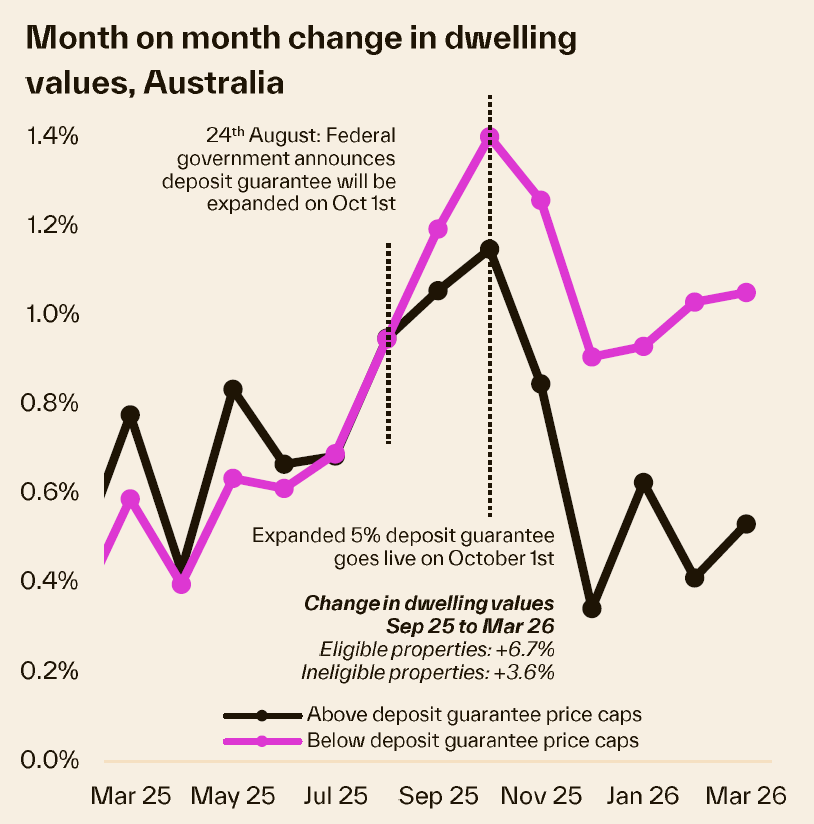 Source: Cotality
Several factors may be contributing to the stronger results at lower price points. Cotality pointed to demand being brought forward, as some buyers moved earlier in anticipation of higher competition and price pressure after the scheme’s launch, including purchasers who may not have needed to rely on the deposit guarantee.
It also cited serviceability constraints. Cotality said higher values, combined with elevated interest rates, were likely pushing demand towards more affordable properties.
Investor activity may be adding pressure in the lower-priced segment. Cotality said investors comprised 40% of mortgage demand in the December quarter, above the decade average where investors typically account for about one third of mortgage demand, increasing competition with first-home buyers and other owner-occupiers.
Cotality said the universe of suburbs with median values below the caps is shrinking as prices rise. At the end of September last year, 48.6% of suburbs nationally had a median house value below the caps, and 92.7% had a median unit value below them. By the end of March, these shares had fallen to 39.5% and 89.1%.
Darwin, the only capital city where caps were not lifted in October, has the smallest share of suburbs under the thresholds. Cotality said 10.3% of suburbs were below the $600,000 house cap in March, down from 32.4% in September, while 95.2% were below the unit caps.
Perth also recorded a sharp decline. In March, 11.6% of suburbs had a median house value below the price caps, down from about one third in September. Cotality said 72.6% of Perth suburbs had a median unit value below the caps, the lowest share of any capital or rest-of-state region.
Despite high prices, Sydney had the largest share of suburbs with median house values under the caps, reflecting the $1.5 million threshold. Cotality said 46.8% of Sydney suburbs were below the cap in March, slightly down from 47.8% in September. It also cited relatively mild growth in Sydney house values over the period, up 0.4% over six months.
According to Cotality, another barrier for first-home buyers is servicing a mortgage at a 95% loan-to-value ratio. It cited ABS lending indicators showing the average first-home buyer loan size rose 7.7% in the December quarter to $606,400. Since then, interest rates have increased by 0.5 percentage points, which according to data, reduces borrowing capacity by about $34,300 for a household on $100,000.
With a three percentage point serviceability buffer and an average variable mortgage rate of 6.01% in March, Cotality said today’s first-home buyers would need to show they can service their loan at an interest rate of around 9% or higher, with the risk that this assessment rate could rise further.
Over time, Cotality said the scheme is likely to lose stimulatory power as more homes exceed the thresholds and a larger share of prospective buyers hit finance constraints that may tighten further. It said first-time buyer demand for houses is likely to skew towards outer metropolitan areas and regional markets, while units may become a more common option for budget-conscious buyers using the deposit guarantee.
Want to be regularly updated with mortgage news and features? Get exclusive interviews, breaking news, and industry events in your inbox – subscribe to our FREE daily newsletter. You can also follow us on Facebook, X (formerly Twitter), and LinkedIn.