Housing Accord target will remain out of reach without faster delivery and lower costs, industry groups warn

Australia’s home-building pipeline strengthened at the end of 2025, with new dwelling commencements rising, but industry leaders said the figures still point to a widening gap between approvals, starts and finished homes.
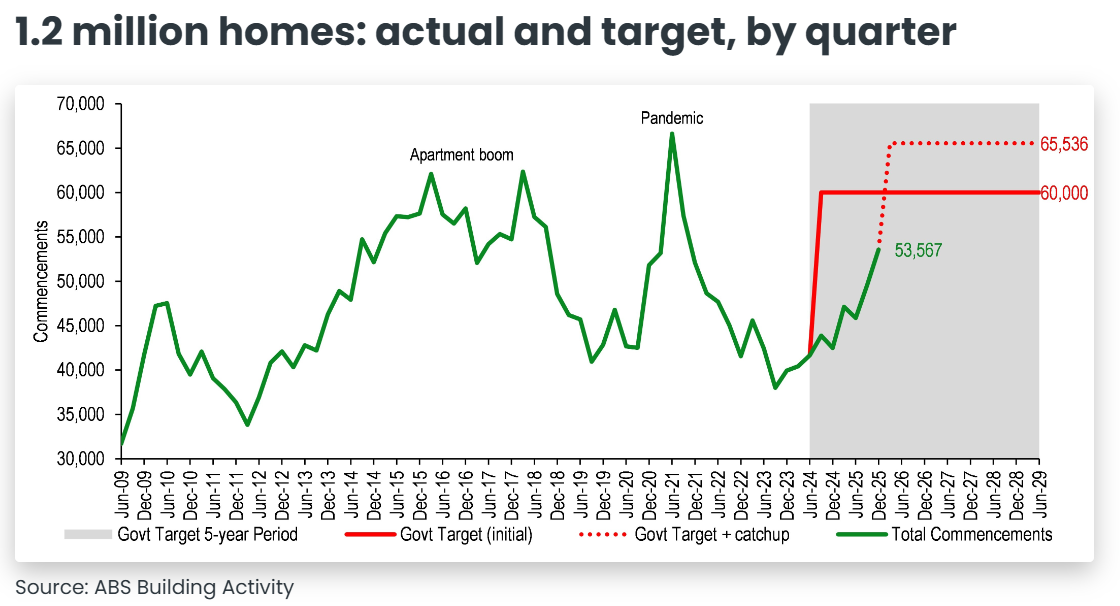
Australian Bureau of Statistics building activity data for the December 2025 quarter showed total dwelling commencements increased 8% to 53,567, driven by a lift in other residential construction. Higher density commencements rose 19.9%, while detached house starts edged down 0.7%. Non-residential building activity was also modestly higher, up 0.3%.
The quarter marked the strongest period for new home starts since September 2021, with higher density commencements recording their best result since September 2018.
Completions, however, moved in the opposite direction. Total dwelling completions fell 1.7% to 43,536 in the quarter and were 3.9% lower than a year earlier, reinforcing concerns that the construction system is struggling to convert projects into finished housing at the pace required.
 Shane Garrett (pictured right), chief economist at Master Builders Australia, said that while lift in activity was encouraging, it was insufficient to meet the National Housing Accord’s targets.
“Australia has amassed a 77,500-home shortfall since the start of the National Housing Accord, with these latest figures meaning that an unprecedented 262,140 new homes per year need to be built over the remainder of the Accord’s term to 2029,” he pointed out.
 Matthew Kandelaars (pictured right), executive director policy and advocacy at the Property Council of Australia, argued that stronger commencement numbers alone would not resolve the supply deficit if completions continue to lag.
“The constraint on housing supply sits after planning approval, with post-permit processes, lack of housing-enabling infrastructure, slow coordination with utilities and rising costs all reducing the rate at which approved projects are completed,” he said.
Kandelaars added that investor sentiment matters as cost pressures re-emerge. “At a time of extreme uncertainty, we need a laser-like focus on maintaining investment confidence, clearing delivery constraints and boosting productivity,” he stressed.
“Global capital is actively seeking long-term exposure to housing markets around the world, but it is increasingly discriminating between markets that merely approve housing and markets that can deliver it consistently at scale.”
Separately, the Housing Industry Association said that as interest rates rise again, lifting supply would hinge on governments cutting other costs in bringing new homes to market.
 “This includes reducing taxes on housing, not increasing them. Housing is one of the most heavily taxed items in our economy along with the ‘sin taxes’ of alcohol and tobacco,” stated Tom Devitt, senior economist at the Housing Industry Association. “Recent discussion around increasing capital gains tax on investors and winding back negative gearing is pointing the conversation in precisely the wrong direction.
“In the last year, investors were responsible for over 40% of new home building across Australia. Attempts to tax them out of the housing market will reduce the supply of new homes without affecting housing demand.”
 For Denita Wawn (pictured right), chief executive of Master Builders Australia, the upcoming federal budget in May would be a key moment to accelerate progress towards the Accord’s five-year target. “The policy measures in the budget must be holistic and must stimulate an increase in all construction including new housing supply through a range of programs, tax settings and workforce growth,” she stated.
Want to be regularly updated with mortgage news and features? Get exclusive interviews, breaking news, and industry events in your inbox – subscribe to our FREE daily newsletter. You can also follow us on Facebook, X (formerly Twitter), and LinkedIn.