REIQ data show double-digit annual growth across many areas, with supply constraints still the central issue

Queensland dwelling prices rose again in the December 2025 quarter, with the Real Estate Institute of Queensland (REIQ) pointing to constrained construction activity and fewer established homes coming to market as the main drivers.
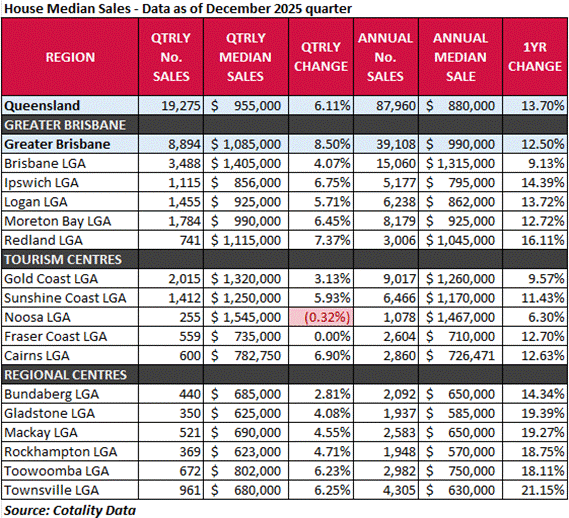
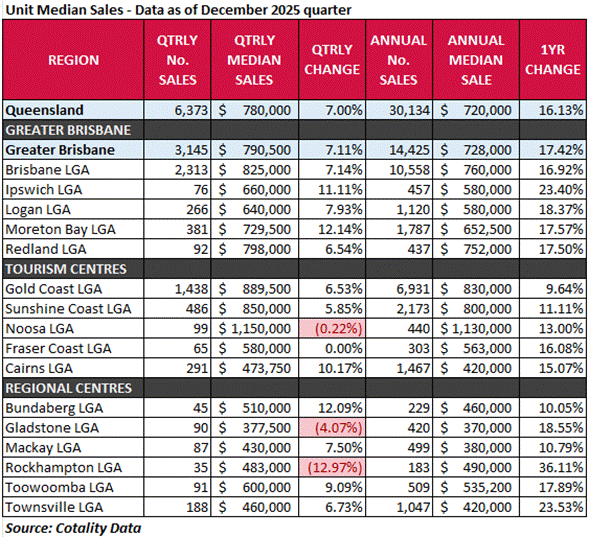
REIQ median sales figures for October to December 2025 show the statewide median house price increased 6.11% over the quarter and 13.7% over the year. Unit medians moved higher still, up 7% over the quarter and 16.13% year on year.
Brisbane’s medians also increased, though several regional markets grew faster. The city’s quarterly median for houses rose 4.07% to $1.4 million while units increased 7.14% to $825,000.
Statewide, the median house sale price reached $955,000 in the quarter, with REIQ citing an annual median of $880,000. In Greater Brisbane, Redland City recorded the strongest quarterly lift among local government areas (LGAs) for houses, rising 7.37% to a median of $1.12 million after entering the million-dollar bracket in the previous quarter.
Among the strongest quarterly performers after Redland City were Cairns (up 6.9% to $782,750), Ipswich (up 6.75% to $856,000), Moreton Bay (up 6.45% to $990,000) and Townsville (up 6.25% to $680,000).
By annual growth, Townsville led house price gains (21.15%), followed by Gladstone (19.39%), Mackay (19.27%), Rockhampton (18.75%) and Toowoomba (18.11%). REIQ reported that Redland City’s annual house median was up 16.11% to $1,045,000.
Brisbane recorded the most house sales in the quarter (3,488), ahead of Gold Coast (2,015), Moreton Bay (1,784), Logan (1,455) and Sunshine Coast (1,412). Median days on market for houses across Queensland lengthened to 22 days, with faster selling conditions reported in Rockhampton (14 days) and Toowoomba (15 days). Noosa recorded the slowest median time to sell at 49.5 days.
In the unit market, Moreton Bay (up 12.14% to $729,500) and Bundaberg (up 12.09% to $510,000) led quarterly gains, followed by Ipswich (up 11.11% to $660,000) and Cairns (up 10.17% to $473,750). Toowoomba rose 9.09% to $600,000.
REIQ noted Rockhampton units fell 12.97% over the quarter but said the result was based on 35 sales and not considered statistically significant; its annual unit median was reported up 36.11% to $490,000, the strongest 12‑month increase in the state.
Brisbane recorded 2,313 unit sales for the quarter, with Gold Coast at 1,438. Noosa remained the highest-priced unit market with a quarterly median of $1.15 million, ahead of Gold Coast ($889,500), Sunshine Coast ($850,000) and Brisbane ($825,000). Across Queensland, units took a median of 20 days to sell, three days longer than a year earlier, with Toowoomba the quickest at 10.5 days.
REIQ said the price trend was occurring alongside a supply gap that remains well short of targets under the National Housing Accord.
 “We’re still not building at the scale and speed we need to relieve the supply squeeze, and with every quarterly target not met, we’re falling further behind,” said Antonia Mercorella (pictured right), chief executive of Real Estate Institute of Queensland.
“Under the National Housing Accord set from mid-2024, Queensland needs to build just over 49,000 new dwellings each year over five years – however, over each of the last four quarters (data to September 2025), only about 34,000 new dwellings were completed.
“Further, the pipeline is far from full. In January this year, there were only 3,600 building approvals, compared with approximately 4,100 required each month. Approvals are currently running at 42,700 per annum – which is approximately 13% below the target. The properties we do have in the pipeline are heavily skewed towards high-end product – such as luxury apartments – due to high construction costs influencing feasibility.”
According to Mercorella, the established housing market is still drip-feeding properties for sale but remains restricted as property owners hold on tight to their homes.
“Total listings during December 2025, show the Brisbane market had a 25% fall in listings relative to the equivalent period last year, while regional Queensland fell 15%,” she said. “This was not just a seasonal phenomenon, with recent February data suggesting similar shortfalls.
“These persistent supply pressures are what’s underpinning property price growth, along with ongoing demand-side factors such as high interstate migration, expected strong population growth, and rental market strain seeing tenants transition to home ownership.
“First-home buyers were also buoyed by the Federal Government’s 5% Deposit Scheme this quarter which came into effect on 1 October 2025, lowering the deposit barrier to entry with property price thresholds of $1 million in Brisbane, Gold Coast and the Sunshine Coast, and $700,000 in other Queensland areas.
“Competition for housing is intensified around the lower quartiles of the market where affordability is greatest and it’s perceived potential gains are highest, and this demand tapers off as you move up the price spectrum, reflecting an increasingly divided two-speed market.”
Mercorella also pointed out that broader cost pressures could further complicate delivery of new homes. “While we’re all feeling the impact of global conflict at the petrol pump, the flow on inflationary impact to manufacturing and construction, through higher transport and logistics costs, couldn’t come at a worse time,” she said.
“Counting the cranes on the horizon has traditionally been a promising sign of what’s in the immediate pipeline, but with high-cost risks and exposure for builders and developers comes uncertainty.
“We’re already up against low productivity, rising material costs, and dire labour shortages in the context of Olympics-related infrastructure projects, so unfortunately this does not bode well for new housing supply.”
Want to be regularly updated with mortgage news and features? Get exclusive interviews, breaking news, and industry events in your inbox – subscribe to our FREE daily newsletter. You can also follow us on Facebook, X (formerly Twitter), and LinkedIn.