New report shows rents picking up again, with Sydney still the priciest capital

Australian tenants are allocating a record portion of household income to rent, as a shortfall in available properties keeps pressure on prices.
According to Cotality’s Rental Review for the March quarter, national dwelling rents rose 2.1% over the three months to March 2026, up from 1.2% in the December quarter. It marked a renewed lift from the 0.9% increase recorded in the September quarter of 2025.
Annual growth has also strengthened. National rents were 5.7% higher than a year earlier, compared with 5.2% in the December quarter and a low point of 3.4% in mid-2025.
Affordability has worsened as rents have outpaced incomes. Households are now committing 33.1% of gross median income to rent, Cotality said, compared with 26.2% in September 2020. The property data and analytics provider estimated that five years of rent increases had added about $202 a week to the typical household rent bill.
 “Rent growth had moderated through much of 2024 and into mid-2025, but there’s been a lack of supply to meet the demand, which is placing immense pressure on the rental market,” said Gerard Burg (pictured right), head of research at Cotality Australia.
“Vacancy rates remain very tight nationally and the volume of available rental properties is well below where it needs to be. Until supply catches up meaningfully with demand, rental growth is likely to stay elevated.”
National rental listings were about 18% under their five-year average, the report said. The shortfall was most pronounced in Sydney and Melbourne, where available stock was 27.4% and 21% below longer-term levels, respectively.
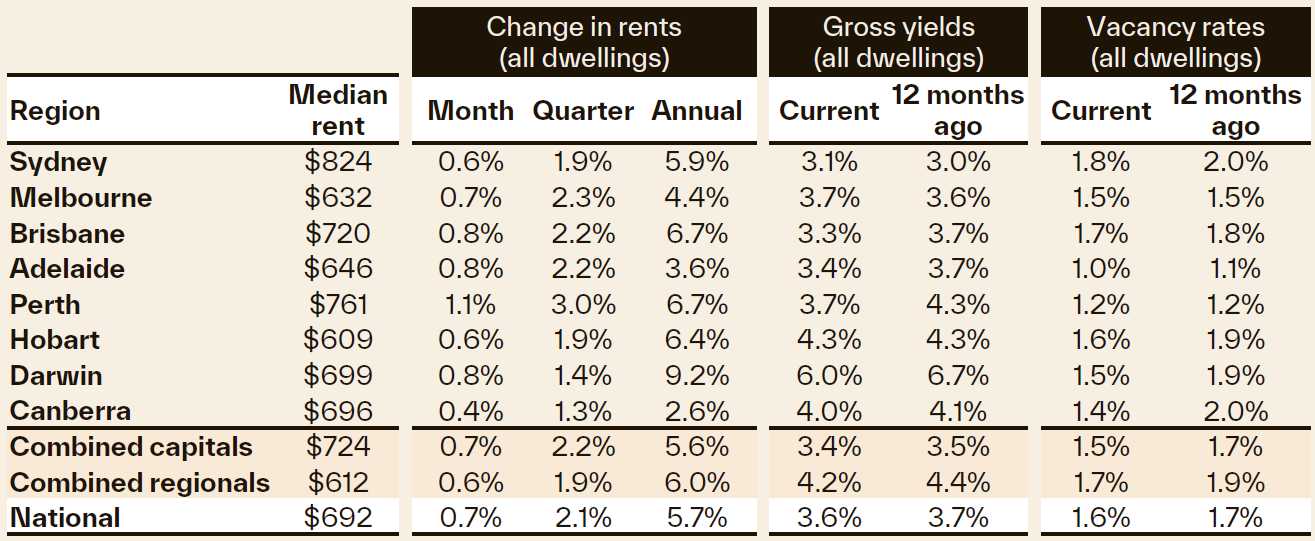
Vacancy rates were below 2% in every capital city during the March quarter. The national vacancy rate was 1.6%, roughly half the 3.2% average recorded over the five years to March 2021. Adelaide and Perth were the tightest markets, with vacancy rates of 1.0% and 1.2%.
“Low vacancy rates and a shortage of available listings have persisted across most capital cities for several years now, and there is little in the current data to suggest conditions are improving,” Burg said.
“When vacancy rates fall to 1.5% or less, it leaves renters with very little negotiating power and fewer options. It means renters have to consider alternate options such as share houses, moving to a new area or back in with family.”
 Source: Cotality
Darwin recorded the strongest annual rise among the capitals, with rents up 9.2% over the year to March to $699 a week. Perth and Brisbane followed, each up 6.7% over the year.
Sydney remained the country’s most expensive rental market, with the median rent rising 5.9% over the year to $824 a week in March 2026.
Melbourne posted the slowest annual increase among mainland capitals at 4.4%, with a median rent of $632 a week. That was the lowest of the mainland capitals, narrowly above Hobart at $609.
 Source: Cotality
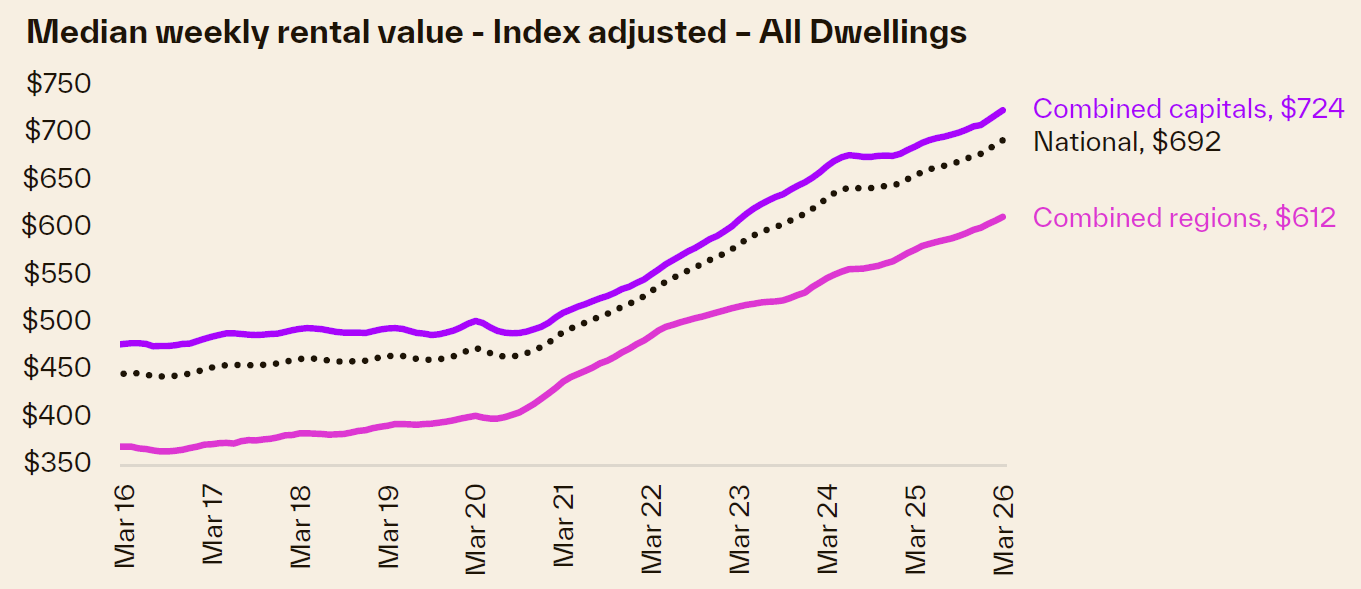
Regional rents increased 6% over the year to March, slightly faster than the combined capitals at 5.6%. The regional median rent was $612 a week, compared with $724 across the combined capitals. Vacancy rates were marginally higher outside the capitals at 1.9%, versus 1.7% for capital cities.
Cotality’s figures showed unit rents have risen faster than house rents over the past five years, up 46.9% since March 2021 compared with 39.0% for houses. Over the March quarter, unit rents increased 2.5%, compared with 2.0% for houses.
“The stronger relative growth in unit rents is now less about catch-up and more consistent with renters seeking affordable options as overall rent levels remain elevated,” Burg said. “As total weekly rent prices continue to increase, we’ve seen demand shift toward more accessible price points, and units are bearing the brunt of that competition.”
Cotality expects limited new supply and persistently low vacancy rates to keep upward pressure on rents in the near term, even as affordability remains at its most stretched level on record.
The report also noted that the renewed acceleration in market rents could feed into headline inflation, with rent increases not yet fully reflected in inflation readings.
“The rental market continues to exert upward pressure on the broader economy in ways that extend beyond housing,” Burg said. “With vacancy rates showing little sign of meaningful improvement and market rents reaccelerating, the flow on impact rents have to CPI data will remain an important factor for policymakers to navigate in the months ahead.”
Want to be regularly updated with mortgage news and features? Get exclusive interviews, breaking news, and industry events in your inbox – subscribe to our FREE daily newsletter. You can also follow us on Facebook, X (formerly Twitter), and LinkedIn.