
March quarter data shows rent growth is stalling in several capitals despite tighter supply

Australia’s rental squeeze is entering a new stage, with household budgets now acting as the main brake on rent increases even as vacancies tighten further, property platform Domain said.
Its latest Rental Report for March 2026 found the national vacancy rate fell to a record 0.7% in the March quarter. Competition remains intense across most capital cities, but rent rises are no longer consistent nationwide, with growth flattening in some markets and diverging sharply in others.
Domain said the change reflects a ceiling on what tenants can pay. The March quarter is typically a stronger period for rental growth, but the report suggests renters are increasingly unwilling or unable to accept further increases.
 “Three months ago, we warned that renters were running out of capacity to absorb higher rents,” said Nicola Powell (pictured right), chief residential economist at Domain. “Even during the usually stronger March quarter, this month’s data shows that affordability ceiling has now been reached.
“Vacancy rates are lower than ever and supply remains incredibly tight, but rent growth is no longer accelerating everywhere. That tells us households simply can’t stretch any further.
“In many cities, we’re seeing rents hold flat or rise unevenly despite worsening shortages. Affordability, not demand, is now the key constraint.”
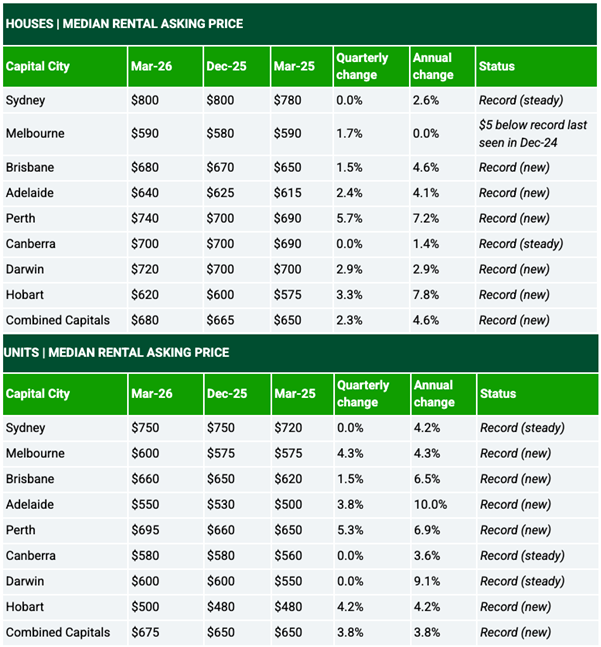
In Sydney, Domain reported weekly rents were unchanged at $800 for houses and $750 for units, describing it as the first time in five years that rents have stalled across multiple quarters despite very tight conditions.
Across other capitals, the report pointed to varied outcomes. Perth recorded the strongest rebound in rents, while Brisbane continued to post steady gains. Melbourne’s improvement was described as inconsistent, and Adelaide’s recent lift in rents appeared more seasonal than enduring.
Source: Domain
The report also noted shifting behaviour among renters, including increased interest in cheaper suburbs, larger households and more caution when inspecting and applying for properties. The report said tenants are becoming more price-sensitive, taking longer to commit and more prepared to walk away when asking rents move ahead of incomes.
Units were identified as a partial pressure valve in several cities, with some renters moving from houses to apartments to manage costs. But Domain said limited stock—and a shortage of suitable, family-friendly apartments—means the shift cannot fully offset broader supply constraints.
“Rental conditions still favour landlords due to the lack of supply, but the pace of growth is not being sustained at high levels,” Powell pointed out. “This isn’t because conditions have eased, but because renters have hit their limits.”
Want to be regularly updated with mortgage news and features? Get exclusive interviews, breaking news, and industry events in your inbox – subscribe to our FREE daily newsletter. You can also follow us on Facebook, X (formerly Twitter), and LinkedIn.


