
Investment and payment redirection scams drive the largest losses

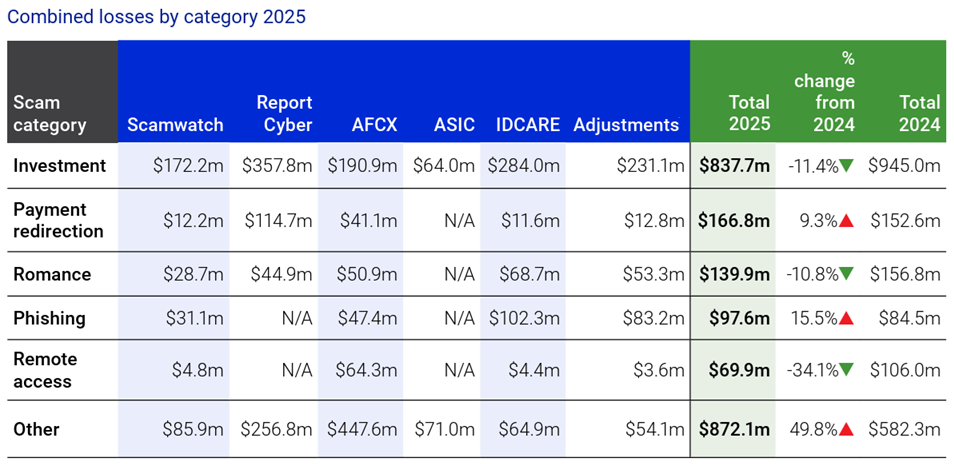
Australians reported $2.18 billion in scam losses in 2025, from 274,577 reports involving financial harm, out of 481,523 total scam reports lodged across Scamwatch, ReportCyber, the Australian Financial Crimes Exchange (AFCX), IDCARE and the Australian Securities and Investments Commission (ASIC).
Losses rose 7.8% on 2024, although the report said overall losses remain down 29.7% from the 2022 peak of $3.1 billion.
By value, the five largest scam categories were investment scams ($837.7 million), payment redirection scams ($166.8 million), romance scams ($139.9 million), phishing scams ($97.6 million) and remote access scams ($69.9 million), accounting for 60% of losses.
 “Scams are often described as a ‘wicked problem’ because they are complex, fast-evolving, and resistant to simple solutions,” said Catriona Lowe (pictured right), deputy chair at the Australian Competition & Consumer Commission (ACCC).
“The Targeting Scams Report provides an overview of the scam landscape and highlights the collaboration and shared accountability needed to tackle the harm caused by scams both here in Australia and globally.”
Earlier this month, Australia joined other G7 countries in endorsing a Call to Action to Combat Fraud at a United Nations and Interpol Global Fraud Summit, and more than 100 organisations endorsed a Public Private Partnership Framework to lift global cooperation.
“As Australia and indeed the world faces increasing sophistication in scam activity through artificial intelligence (AI) and the industrialisation of criminal syndicates through scam compounds, it is clear more needs to be done, quickly and at scale,” Lowe said.
“It’s also important to note that the actions demonstrated in the report are made possible because Australians took the time to share their experiences. Without people speaking up, we simply wouldn’t have the insights needed to track and disrupt scam activity. We encourage people to report suspicious activity so we can continue improving our understanding and response to scams.”
 Source: National Anti-Scam Centre
Phishing was the most reported scam type to Scamwatch in 2025, with 65,361 reports. The report said betting and sports investment scams rose, with $2.4 million in losses and a 19.6% lift in reports from 2024 to 2025, largely linked to activity sometimes called “scambling”.
Australians aged 65 and over accounted for 26.5% of Scamwatch losses, despite representing about 17.1% of the population, the report said. Online contact methods were linked to rising harm, with reports involving a loss up 31.8% and losses up 21% in 2025.
Text-message scam contacts fell to 29,058 in 2025, from 77,365 in 2024.
The National Anti-Scam Centre said it referred more than 8,400 websites for assessment, leading to the removal of more than 7,500 scam URLs; referred more than 7,000 suspected Facebook scam URLs to Meta; and referred 844 Gmail accounts, 14 organic YouTube URLs and 2,098 advertisements to Google. It also referred 4,246 phone numbers and 921 sender IDs to telecommunications partners.
“The Targeting Scams Report reinforces that scam prevention requires a coordinated, whole-of-ecosystem approach,” Lowe said. “The National Anti-Scam Centre continues to work with partners to detect threats, share intelligence, and disrupt scams, quicker and at scale.
“We know losses remain high, but coordinated interventions are key to combating scams, and we will continue working together to strengthen efforts, including through the Scams Prevention Framework.”
Want to be regularly updated with mortgage news and features? Get exclusive interviews, breaking news, and industry events in your inbox – subscribe to our FREE daily newsletter. You can also follow us on Facebook, X (formerly Twitter), and LinkedIn.


