
Shift to land tax urged to ease housing affordability crisis

Australia’s housing market is being stifled by the growing burden of stamp duty, with one property market expert urging the government to replace it with a fairer, more efficient land tax.
As the Commonwealth prepares for its Economic Roundtable, Domain’s chief of research and economics, Nicola Powell (pictured), has called for urgent reform, describing stamp duty as “one of the most damaging taxes in Australia – distorting housing decisions, penalising mobility, and locking people out of home ownership.”
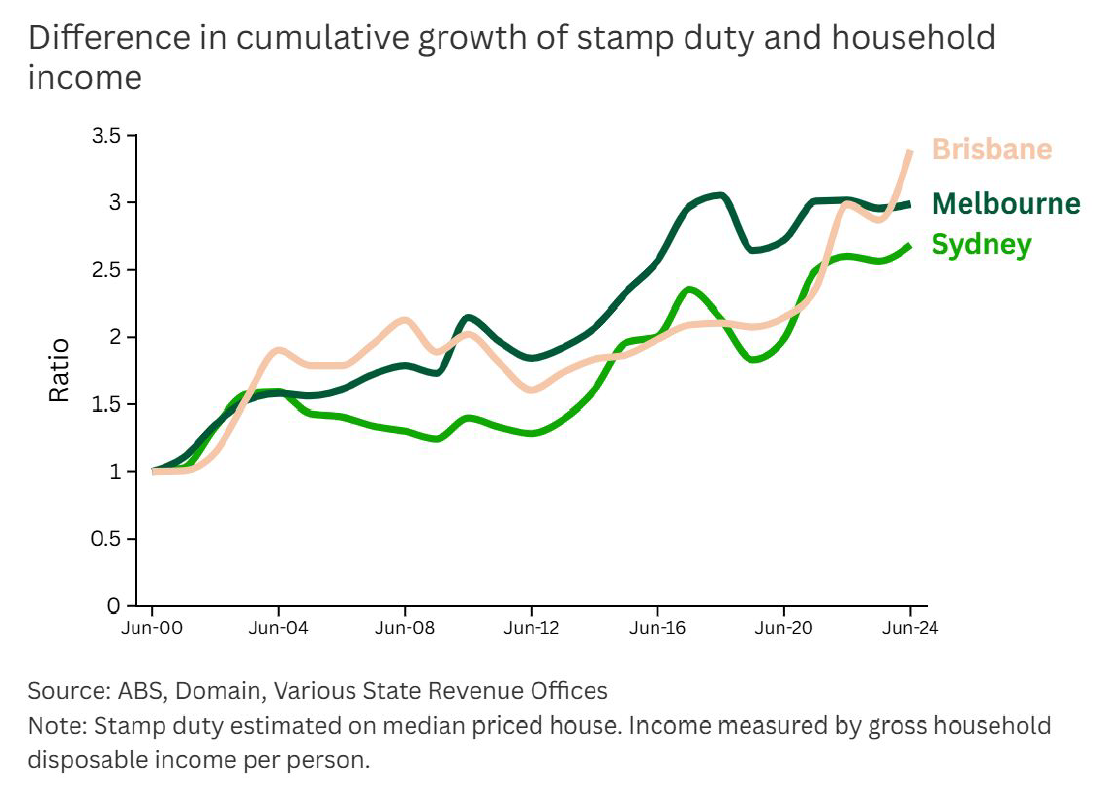
Domain’s recent analysis highlights that stamp duty costs have soared far beyond income growth, especially in the eastern states, where stamp duty costs have grown between 2.7 and 3.4 times faster than incomes since 2000.
In Sydney, the stamp duty on a median-priced house has jumped from 45% of gross household disposable income per capita in 2000 to a staggering 120% in 2024. This shift has turned what was once a relatively manageable upfront expense into a significant barrier, forcing buyers to save for longer and pay more – on top of already steep deposits.
The analysis also underscores the far-reaching consequences of stamp duty, starting with the impact on individual buyers and rippling through to the broader economy and state finances. Powell said that stamp duty discourages people from moving for job opportunities or to homes that better suit their needs, and even deters about 25% of potential downsizers. It also limits the ability of workers to relocate to where skills are most needed, reducing the dynamism of labour markets and cities, she argued.
According to Powell, the economic cost is stark. “For every dollar it raises, around 70 cents of potential economic activity is lost,” she said. “By contrast, raising the same amount through a broad-based land tax costs the economy less than 10 cents.” She added that the volatility of stamp duty revenues also exposes state budgets to damaging swings, while the tax falls disproportionately on younger Australians and frequent movers.
Domain singles out the ACT as a model for reform, having begun a 20-year transition from stamp duty to a broad-based land tax in 2012. This approach, Powell pointed out, “avoided fiscal shocks, gave households time to adjust, and ensured all properties contributed to revenue.” However, efforts in other states, such as NSW’s short-lived opt-in model for first-home buyers, have faltered without bipartisan support.

Powell stressed that national leadership is essential, as the core barrier is fiscal. “Stamp duty delivers large, immediate revenues to state governments, while land tax produces smaller, more predictable flows over time,” she said. “Bridging that short-term revenue gap is difficult for states to manage alone.” Federal support, she believes, would make the shift both politically and financially viable.
Addressing concerns that a land tax could inflate property prices, Domain finds the short-term impact would be minimal and likely offset by higher annual charges. Over time, the reform could lead to a more efficient use of housing – particularly lowering prices for larger homes that are currently held onto due to high transaction costs.
“Stamp duty is a relic of an earlier era: a blunt, inefficient tax from a time when property values were modest and mobility less vital to economic growth,” Powell said. “If governments are serious about improving housing affordability, labour market dynamism and productivity, replacing it with a broad-based land tax is one of the clearest wins available.
“The economics are settled. The barrier is politics.”
Want to be regularly updated with mortgage news and features? Get exclusive interviews, breaking news, and industry events in your inbox – subscribe to our FREE daily newsletter. You can also follow us on Facebook, X (formerly Twitter), and LinkedIn.


