Regional movers push further north

The Sunshine Coast remains a leading destination for Australians relocating from capital cities, but regional Australians are increasingly choosing different parts of the country, according to the latest Regional Movers Index (RMI).
The index, produced by the Regional Australia Institute (RAI) and backed by Commonwealth Bank data, shows that net migration into the Sunshine Coast and Greater Geelong continues, though volumes are lower than at the same point last year.
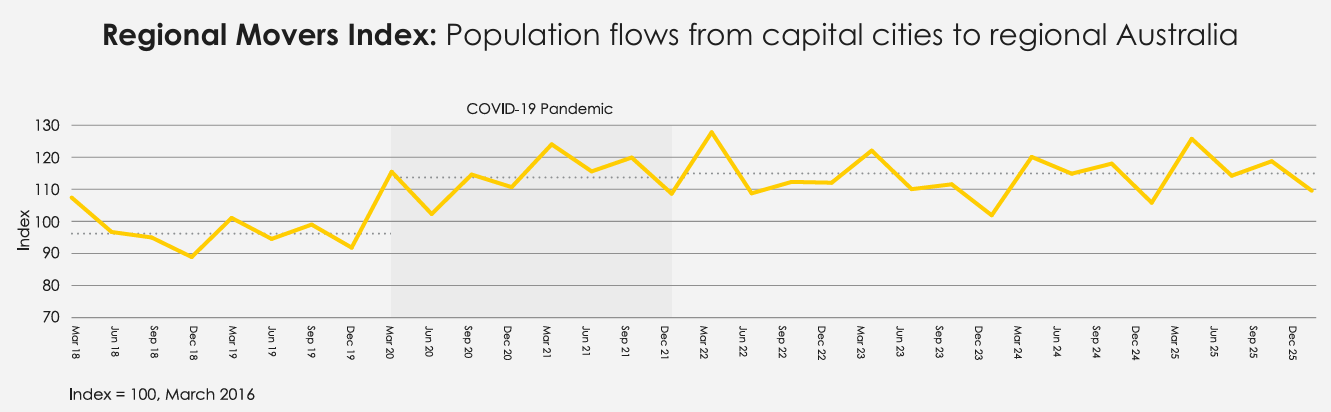 Sources: Regional Australia Institute and Commonwealth Bank
The top five locations for net internal migration were the Sunshine Coast and Greater Geelong, followed by the Fraser Coast in third place. Lake Macquarie slipped to fourth, ahead of Moorabool in fifth.
The Fraser Coast, which includes Hervey Bay and Maryborough and sits north of the Sunshine Coast, has become a stronger draw for people shifting between regional areas rather than from a capital city.
 “We are seeing a trend of capital-city dwellers still choosing popular locations, but regional-to-regional movers looking elsewhere,” said Liz Ritchie (pictured right), chief executive of the Regional Australia Institute. “Queensland remains popular, but regional movers are going further out from the Sunshine Coast in search of affordability.
“We are also seeing residents of Brisbane and Perth seek out the regions in greater numbers, a trend which is gaining momentum. Brisbane, which previously attracted net inflows, recorded net outflows to regional areas.”
December is typically a slower month for relocations, but the RMI indicates the seasonal fall in capital-to-regional moves was smaller than in the previous two December quarters, suggesting the underlying trend remains intact.
Capital-to-regional migration accounted for 11.6% of all relocations between local government areas across Australia. The index described this as the second-highest share since the end of the pandemic in 2022. Moves from capitals to regions also exceeded movement in the opposite direction (regional to capitals) by 31%.
Sydney and Melbourne remained the largest contributors to regional population growth, making up 54% and 38% of net outflows respectively.
“While most city leavers are from Sydney and Melbourne, the other capitals are also seeing outflows,” Ritchie said. “They might be seeking housing affordability or job opportunities.
“What hasn’t declined is interest in a regional move. Capital-to-region migration remains robust, recording the second highest migration figures since the end of the pandemic.
“The RAI has long campaigned for a National Population Plan that recognises regional movement and puts infrastructure and supports in place to ensure regions are ready and able to manage this influx. The RAI remains committed to seeing ‘40 for the Regions’ - a 40% carve out for regional Australia that will see workforce, housing and share of voice delivered to regional Australia.”
Beyond the usual hotspots, the latest Regional Movers Index highlighted stronger annual net growth, in percentage terms, across regional Tasmania, New South Wales, Victoria and Western Australia. Locations cited included Meander Valley and Waratah/Wynyard in Tasmania, Indigo in Victoria, and Albury in New South Wales, as well as Gingin in Western Australia.
“Long-term RMI trends shows solid and consistent growth that we expect to continue,” said Kylie Allen, executive general manager of regional and agribusiness banking at Commonwealth Bank. “It’s a broadening of regional growth beyond the usual hotspots.
“Strong regional-to-regional movement and rising interest in centres like the Fraser Coast signal a maturing migration pattern, where people are making considered, long-term choices about where they live and work. That shift brings real opportunity and reinforces the need for coordinated planning around housing and investment in infrastructure so regions can sustain momentum and support growing communities. It also underpins business confidence and increased demand for locally supplied products and services.”
The bank also pointed to first-home buyer activity outside major cities. Recent Commonwealth Bank data suggests about a quarter of first-home buyers are purchasing in regional or remote areas.
“First-home buyers choosing regional or remote areas can generally buy a larger home at a more affordable price – their average loan size is $400,000 compared with $507,000 in metropolitan areas,” Allen said.
“We’ve also seen double-digit growth in business lending fundings in regional and agribusiness over the past five years. This all adds up to stronger and growing regional economies.”
Want to be regularly updated with mortgage news and features? Get exclusive interviews, breaking news, and industry events in your inbox – subscribe to our FREE daily newsletter. You can also follow us on Facebook, X (formerly Twitter), and LinkedIn.