Pay rose 0.8% over the March quarter; Western Australia leads as jobs growth stays resilient.

Wages growth remained steady at 3.1% over the year to March 2026, with wages up 0.8% over the March quarter, as inflation expectations lift amid the Middle East conflict.
The figures come from Commonwealth Bank’s Wage Insights series, which uses de‑identified salary credits from about 400,000 CBA accounts.
“The CBA Wage insights series continues to show wages growth is steady heading into a period of higher inflation and inflation expectations period due to the Middle East conflict,” said Belinda Allen, head of Australian economics at Commonwealth Bank. “The labour market remains on the tight side with the unemployment rate at 4.3%, according to ABS data.
“However, according to CBA data wages, growth is finding a new base at around 3.1% per year, having hovered between 3.1% and 3.2% since mid-2025. Our data is not yet showing any response to the tightening in labour market conditions through late 2025 and into early 2026. We are expecting some loosening in the labour market as economic growth slows in 2026.”
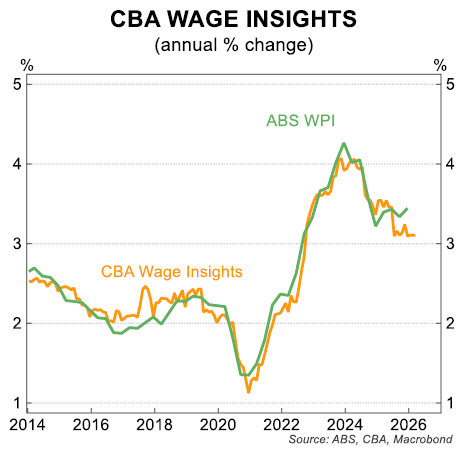
Wages growth remained mixed across the states and territories in March. Western Australia retained the strongest annual pace for a 15th consecutive month, with wages up 3.9% over the year, from 3.8% in February.
Victoria and Tasmania recorded the slowest annual wages growth in March, with both states showing a gradual easing over recent months. Wages growth was steady in New South Wales and the ACT at 3.2% and 3.5% a year. Queensland recorded a slight lift to 3.3%, while South Australia was at 3.4%.
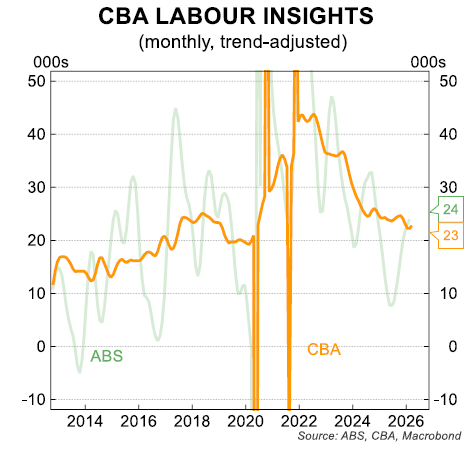
Employment was estimated to have increased by 23,000 jobs in March, a slight rise from February, with the bank’s Labour Insights series pointing to continued resilience despite higher interest rates and the conflict in the Middle East.
Employment growth is settling into a new baseline after stronger outcomes through 2024 and 2025. Allen said the bank still expects the unemployment rate to rise, with the outlook sensitive to geopolitical developments and energy prices.
“In the third month of 2026, employment as shown by CBA data remains resilient in the face of rising interest rates and the Middle East conflict,” Allen said.
“The unemployment rate sits at 4.3%, and at this rate, we still judge the labour market is on the tight side. We do expect the unemployment rate to lift from here, but the exact extent is contingent on the prospects of the proposed cease fire and the level of oil and refined product prices we see moving forward.
“Our internal data does not point to a shift in trend in either direction now for both employment and wages, reinforcing the relatively stable environment we are seeing in the CBA Wage and Labour Insights series.”
Want to be regularly updated with mortgage news and features? Get exclusive interviews, breaking news, and industry events in your inbox – subscribe to our FREE daily newsletter. You can also follow us on Facebook, X (formerly Twitter), and LinkedIn.