Housing credit growth remains steady, but Westpac flags rising risks from March

Australian private sector credit growth strengthened in February, lifting to 0.6% month on month and pushing annual growth to 7.8%, according to Westpac Economics’ latest Australian Private Credit Bulletin.
February’s monthly growth was slightly higher than January’s 0.5% increase, matching the average rate of growth seen in 2025. The annual growth rate, meanwhile, set a new high for the current cycle.
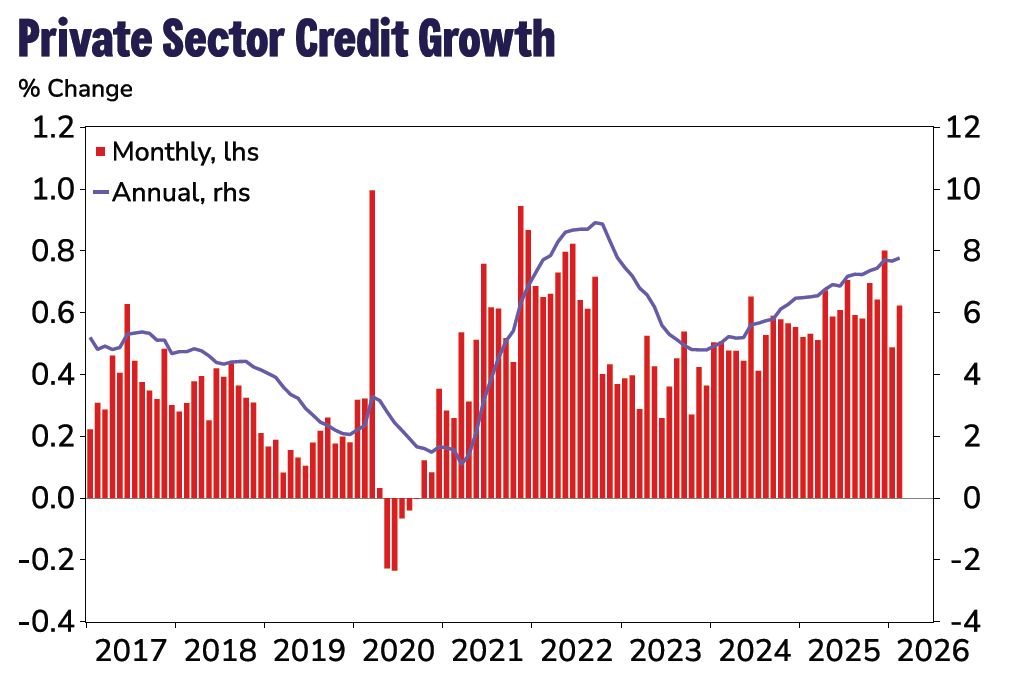 Source: Westpac Economics
 The February reading was broadly in line with expectations, despite the Reserve Bank of Australia’s rate increase in early February. “The latest private sector credit data contained few surprises,” said Mantas Vanagas (pictured right), senior economist at Westpac. “Despite the RBA rate hike, growth momentum remained strong in the month. Total credit rose in line with both our expectations and the consensus.”
According to the report, housing credit remained the key driver, rising 0.6% in February and 7.1% over the year. Westpac noted that housing credit makes up roughly 62% of total private credit stock. The composition of housing borrowing showed little change: owner-occupier credit increased 0.5% for a 13th consecutive month, while investor credit rose 0.7% (after 0.8% in January), with the annual pace for investor credit accelerating to 9.2%.
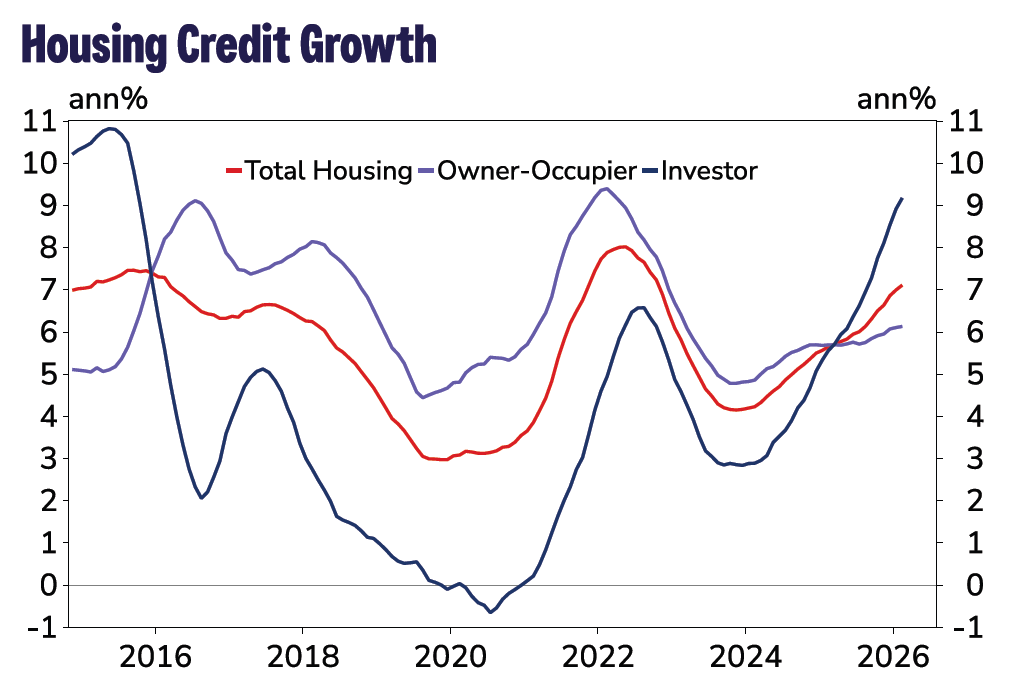 Source: Westpac Economics
Other personal credit, which accounts for around 4% of private credit, increased 0.4% in February, up from 0.2% in January. Westpac said the latest result was closer to the average pace recorded through 2025, suggesting conditions may be returning to a steadier trend after volatility late last year.
Business credit also firmed, rising 0.8% in February after a 0.5% gain in January. Annual business credit growth edged up to 9.5%. Westpac said year-ended growth appears to have stabilised around that rate after nearing 10% mid last year.
| Private sector credit, February 2026 | ||||
|---|---|---|---|---|
| %month | %year | |||
| Item | Jan | Feb | Jan | Feb |
| Total credit | 0.5 | 0.6 | 7.7 | 7.8 |
| Business | 0.5 | 0.8 | 9.4 | 9.5 |
| Other personal | 0.2 | 0.4 | 4.1 | 4.3 |
| Housing, total | 0.6 | 0.6 | 7.0 | 7.1 |
| Owner–occupier | 0.5 | 0.5 | 6.1 | 6.1 |
| Investor | 0.8 | 0.7 | 8.9 | 9.2 |
| Source: ABS, Westpac Economics | ||||
While February lending data showed resilience, Westpac argued the balance of risks is shifting as economic uncertainty intensifies. “From March onwards, risks to credit growth are skewed to the downside,” Vanagas said.
“The ongoing conflict in the Middle East, together with the global energy price shock and supply chain disruptions, will significantly impact the Australian economy. We anticipate a combination of high inflation, slower GDP growth and softer labour market conditions – all negative for the credit growth outlook.”
Westpac added that interest rate settings may tighten further. “We now expect RBA to lift the cash rate at the next three policy meetings, aiming to rein in domestic demand growth and bring inflationary pressures down,” Vanagas said.
Want to be regularly updated with mortgage news and features? Get exclusive interviews, breaking news, and industry events in your inbox – subscribe to our FREE daily newsletter. You can also follow us on Facebook, X (formerly Twitter), and LinkedIn.