Latest data lays bare adverse effects of ongoing Middle East conflict

Australian business confidence has flopped to lows not seen since the height of the COVID-19 pandemic amid the ongoing Middle East conflict.
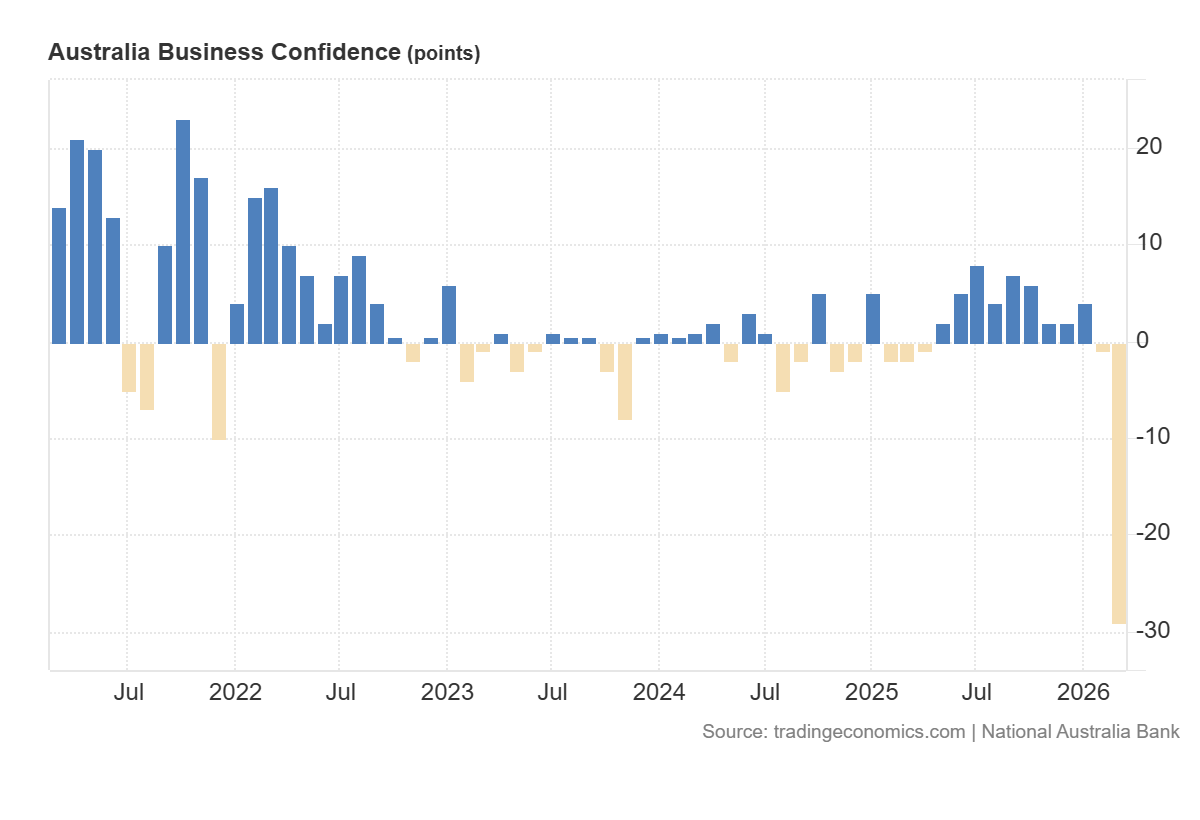
The NAB Business Confidence index plummeted to -29 in March, from -1 in February, representing the largest month-on-month decline since March 2020.
Business are weight up higher input costs and narrower household budgets as energy costs continue to soar.
With Pakistan-mediated peace talks between the US and Iran failing to reach a deal, the US has moved to blockade the Strait of Hormuz, where 20% of all global passes.
Westpac warned today that the supply shock from energy market disruption is expected to result in higher inflation and higher interest rates, while "an expected slowing in economic growth will create a more challenging environment for some customers".
While business conditions remained relatively stable in March (at +6 index points, only slightly below the +7 long run average) NAB head of Australian economics Gareth Spence said it showed how quickly sentiment can respond to global shocks, even as activity data remains more stable in the near term.
“The outbreak of the conflict in the Middle East saw business confidence fall 29 points to minus 29 index points, the second largest monthly fall in the survey’s history, with falls of this magnitude previously only seen in the GFC and the onset of COVID,” said Spence. “Business conditions fell only one point to six index points in March, reflecting that while the global news backdrop has impacted sentiment, it is still early days in terms of the flow through to activity.
“Resilience in business conditions also highlights that the economy had carried a healthy level of momentum heading into the unfolding shock.”"
Forward orders fell sharply in March, erasing gains seen earlier in the year and pointing to rising caution among firms. Capacity utilisation, however, rose to 83.1 per cent and remains well above its long-run average.
“The impact on measures of costs and prices has been immediately obvious, with purchase cost growth in quarterly terms more than doubling to three per cent and product price growth rising to 1.1 per cent," said Spence.
Business confidence is now negative across all states, while business conditions remain positive in most regions. Western Australia and South Australia recorded improvements in conditions over the month, while Victoria saw the largest decline.
Consumer sentiment down
Australia’s consumer mood has also taken a fresh hit, with the Westpac–Melbourne Institute Consumer Sentiment Index tumbling 12.5% in April to 80.1 – marking the biggest monthly decline since the onset of the pandemic and hitting its lowest level in nearly two-and-a-half years.
The slump unwinds March’s modest 1.2% gain, reflecting a double blow from surging fuel costs linked to the US-Israel conflict with Iran, and the latest cash rate hike from the Reserve Bank of Australia (RBA).
Households repored a sharp deterioration in their finances, both compared with a year ago and over the coming 12 months, while views on the economic outlook – particularly over the next year – have soured markedly.
Big-ticket purchases are being shelved, with the 'time to buy a major household item' measure sliding deeper into pessimistic territory, and job security fears rising to their highest level in more than five years.
Westpac’s Matthew Hassan expects the RBA to remain laser-focused on inflation, flagging another 25bp move in May and further tightening ahead.