National dwelling prices tipped to fall 14% from peak as correction sweeps Brisbane and Perth

Commonwealth Bank of Australia (CBA) is warning the nation's housing market is heading for its steepest decline in more than four decades, with national dwelling prices forecast to fall around 14% from their March 2026 peak to their eventual trough – a correction that is moving faster, spreading wider, and cutting deeper than any previous downturn in the 45-year history of the monthly price series.
A downturn unlike any other
In its latest economic forecast update, CBA revised down its dwelling price outlook for the third time in 2026, citing a correction that has accelerated well beyond what its economists anticipated as recently as September. National values are already 6.7% below their March 2026 peak, while the combined five-capital city average has declined 8.2% – the fastest pace of decline in at least 40 years.
The speed of the deterioration has been striking. National dwelling prices fell 1.2% in October alone, the seventh consecutive monthly decline, according to CBA's update, which draws on data from property research firm Cotality.
Sales volumes over the past three months were 23% lower than a year earlier and 18% below the previous five-year average. Auction clearance rates across the combined capitals have fallen below 50%, the median time on market has risen sharply, and vendor discounting has widened to 4.7% – its highest level since May 2019.
Data revisions have compounded the picture. Monthly price growth across May to September has been revised down by an average of 0.5 percentage points nationally, and 0.6 percentage points across the five capitals, compared with first estimates. The revisions confirm the downturn was more firmly established than the available data indicated at the time of CBA's September update.
Where falls are hitting hardest
Sydney has recorded the deepest correction to date, with values 10.1% below their February 2026 peak. CBA now forecasts a peak-to-trough decline of around 16% for Sydney – a fall the bank says would be surpassed in depth only by the city's early-1980s downturn over the past 45 years. Melbourne is forecast to record a peak-to-trough fall of around 13%, with prices already 8.2% below their previous peak.
The most significant shift in CBA's latest update, however, concerns Brisbane and Perth – two markets that had been among the country's strongest performers heading into 2026. Both cities have already exceeded the roughly 8% peak-to-trough declines CBA had forecast as recently as September. Brisbane values fell 2.0% in October and 6.1% over the past three months, while Perth fell 1.7% and 5.7% respectively. CBA now expects peak-to-trough falls of around 18% in both cities.
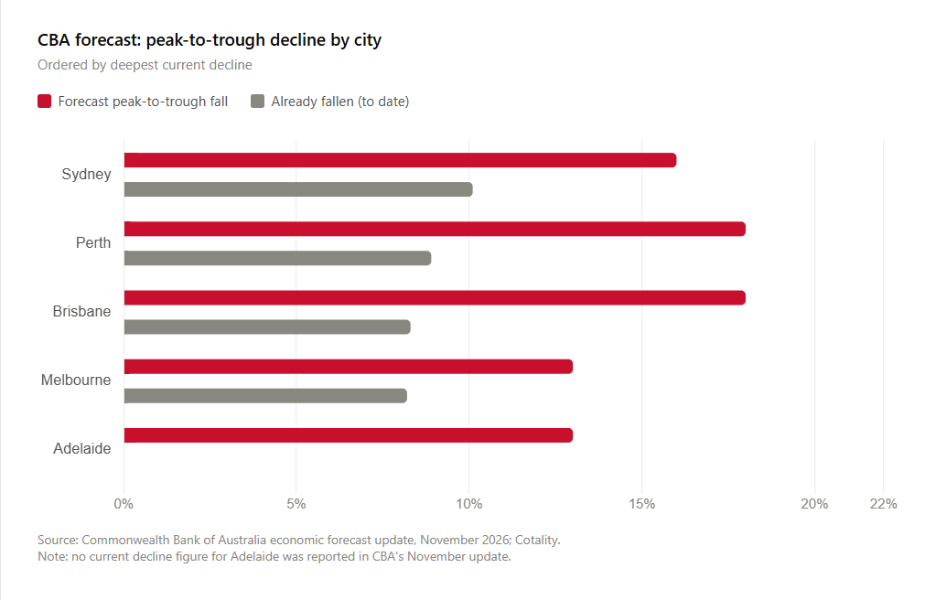
Cotality data cited in the update shows that virtually every suburb across Brisbane, Perth, and Adelaide has recorded a price decline over the past three months. CBA attributes the reversal in the mid-sized capitals to a fading of what it describes as overexuberance – a dynamic where exceptional price gains in 2025 and into 2026 were ultimately driven more by momentum than fundamentals. Adelaide is also now forecast to record a peak-to-trough decline of around 13%.
Rate outlook adds to the pressure
The interest rate environment has also moved against the housing market since CBA's September update. The bank acurately expected the Reserve Bank of Australia (RBA) to raise the cash rate by a further 25 basis points to 4.85% – the same November meeting at which this forecast was published – before holding steady and then cutting by 25 basis points in August and November 2027. That is a higher peak than the 4.6% CBA had assumed in September, with rate cuts also pushed back from May 2027.
CBA estimates that the higher cash rate profile alone reduces 2027 price growth by around two percentage points compared with a scenario where the cash rate had peaked at 4.6%. On CBA's current central forecast, national dwelling prices are expected to fall 8% over calendar year 2026 and a further 3% in 2027, before stabilising in the second half of next year.
A modest recovery is expected once rate cuts arrive, but CBA is not forecasting a strong rebound. The bank's 2027 recovery scenario depends on monetary policy easing beginning in August of that year.
What this means for mortgage brokers
For mortgage professionals, the implications of CBA's updated forecast are significant across several fronts. Borrowers who entered the market near 2026 price peaks, particularly in Sydney, Brisbane, and Perth, with small deposits face mounting risk of negative equity. Loan-to-value ratios are shifting, refinancing conversations are becoming more complex, and serviceability assessments are being conducted against a backdrop of still-rising rates.
Rental yields are expected to rise in response to the price correction. CBA forecasts the national rental yield will increase from approximately 3.75% prior to the May 2026 Budget to around 4.75% by late 2027 – a development that may sustain investor interest in the market even as capital values fall.
For brokers navigating this environment, the CBA forecast represents one of the most significant shifts in Australian housing market fundamentals in a generation. Understanding the depth of the correction – and the conditions required for stabilisation – will be central to advising clients over the next 12 to 18 months.