
A Truework survey of 1,000 recent US homebuyers finds half are banking on rate cuts that may never arrive

America's housing affordability debate has long centered on whether buyers can qualify for a mortgage. A new report from Truework, a Checkr company, suggests the more urgent question is whether they can keep one.
The Truework 2026 Recent Homebuyers Report, "Homeownership on the Edge," found that 85% say refinancing within the next three years is important to their financial health, a sharp rise from 56% in a comparable 2025 survey.
Moreover, 50% say their monthly mortgage payment won't be sustainable unless they can secure a lower rate.
"For decades, the conversation around affordability has focused on whether buyers could qualify for a mortgage," said Randy Lightbody, head of mortgage at Truework in San Francisco.
"Our research shows that many buyers are qualifying based on one payment while planning their financial future around another, even gambling on a rate cut that might never come."
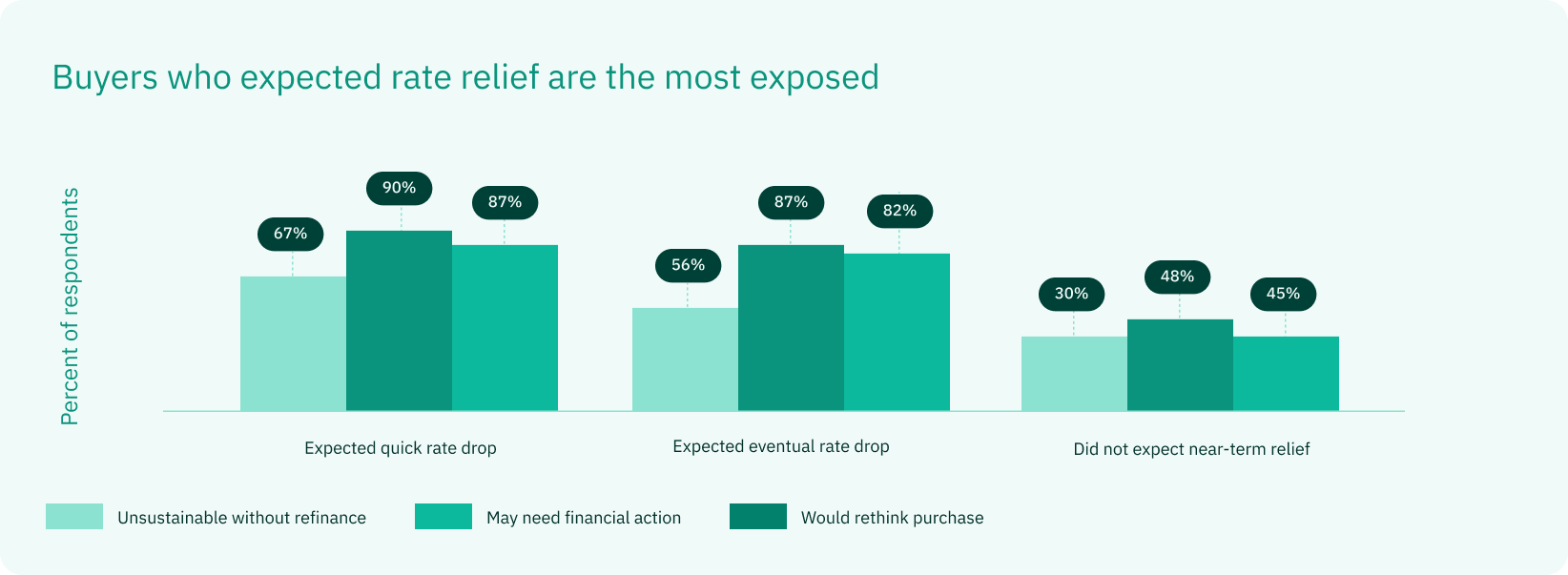
The gamble is widespread. Six in 10 respondents (60%) entered the market expecting rates to fall, and nearly three-quarters (73%) planned to refinance once they did.
For much of this cohort, refinancing wasn't an option — it was the original strategy for making ownership affordable.
Mortgage brokers now working to identify clients most likely to benefit from refinancing their high-rate loans are seeing these dynamics play out on the ground.
Read more: Most Americans now favor buying over renting, new BofA data shows
When the math doesn't hold
The strain is already reshaping daily life. According to the Truework report, 32% of recent buyers have cut spending on basic necessities, 20% have reduced retirement contributions, and 13% have considered delaying having children due to mortgage costs.
Mark Worthington, a branch manager at Churchill Mortgage, previously told Mortgage Professional America that millennial buyers face persistent affordability pressures from rising ongoing monthly expenses — including streaming services and delivery subscriptions — compounding the squeeze.
Vulnerability runs deep. The report found that 88% of recent buyers say at least one common financial setback could jeopardize their mortgage payment, with 67% identifying job loss as the primary risk and 44% citing an unexpected medical expense.
Max Slyusarchuk of A&D Mortgage says years of elevated mortgage rates have created a growing pipeline of future refinance opportunities, with rates below 6% potentially triggering a surge in borrower demand.https://t.co/HyJ4SNaNnH
— Mortgage Professional America Magazine (@MPAMagazineUS) July 22, 2026
Millennials carry the heaviest load
Among Millennials, 53% say their mortgage is unsustainable without a refinance, versus 43% of Gen X buyers.
Millennials were also more likely to have purchased expecting rates to drop (79% versus 64% of Gen X), and 45% expect to take on a second job if refinancing doesn't materialize, compared with 35% of their Gen X peers.
Across all respondents, the fallout if rates don't cooperate is severe: 40% expect to take on additional work, 22% anticipate relying on credit cards for everyday expenses, and 21% expect to withdraw from retirement savings to stay current.
For brokers conducting proactive mortgage reviews for recent homebuyer clients, the Truework numbers make the case for outreach now rather than waiting for a rate trigger.
Meanwhile, a new annual survey from TD Bank revealed a cohort that is optimistic but stretched, and increasingly open to financial strategies that would have seemed unconventional just a few years ago.
Nearly three-quarters of respondents said they would consider a 50-year mortgage if one were available, while 78% of younger millennials and 74% of Gen Z respondents indicated they would tap their 401(k) to fund a first home purchase if permitted to do so.
Half of those surveyed said they would be comfortable buying a fixer-upper under current market conditions.
Read more: Gen Z claims a record share of US purchase mortgage market
"The true cost of homeownership extends far beyond the purchase price or the monthly mortgage payment," Lightbody said.
"It's showing up in the everyday decisions families are making, whether that's putting off having children, delaying retirement, taking on additional work, or simply cutting back on basic necessities."
The survey was conducted by Wakefield Research among 1,000 nationally representative US adults who purchased a home within the past 24 months, from May 22 to June 4. The margin of error is ±3.1 percentage points at the 95% confidence level.
Stay updated with the freshest mortgage news. Get exclusive interviews, breaking news, and industry events in your inbox, and always be the first to know by subscribing to our FREE daily newsletter.


