
New Cotality data shows conflagration risk is reshaping wildfire exposure

More than 2.5 million properties across 10 western states carry a combined reconstruction cost value of nearly $1.4 trillion in wildfire exposure, according to Cotality's 2026 Wildfire Risk Report, released today.
California holds the largest share, with 1.28 million at-risk properties representing $850 billion in reconstruction cost value (RCV).
However, the report challenges any assumption that wildfire is a California-contained problem, and for brokers operating in adjacent markets, the implications are increasingly hard to dismiss.
Risk spreads well beyond California
Close to half of all at-risk properties in the top 10 states, or 49.9%, sit outside California.
Colorado and Texas together account for roughly 560,000 at-risk properties and $252 billion in RCV, nearly matching the $277 billion carried by the remaining seven states — Oregon, Arizona, Idaho, New Mexico, Montana, Washington, and Utah — combined.
At the metro level, Los Angeles remains the single most exposed market, with nearly 250,000 at-risk properties and $209 billion in RCV.
Austin, Texas follows as the leading non-California metro, with more than 100,000 at-risk properties and $49.2 billion in RCV, ahead of San Antonio, Denver, and Spokane, Washington.
As the homeowners insurance crisis has evolved into a structural mortgage origination problem, the coverage complications and debt-to-income disruptions once concentrated in California are beginning to reach states where brokers had not previously needed to account for them at the preapproval stage.
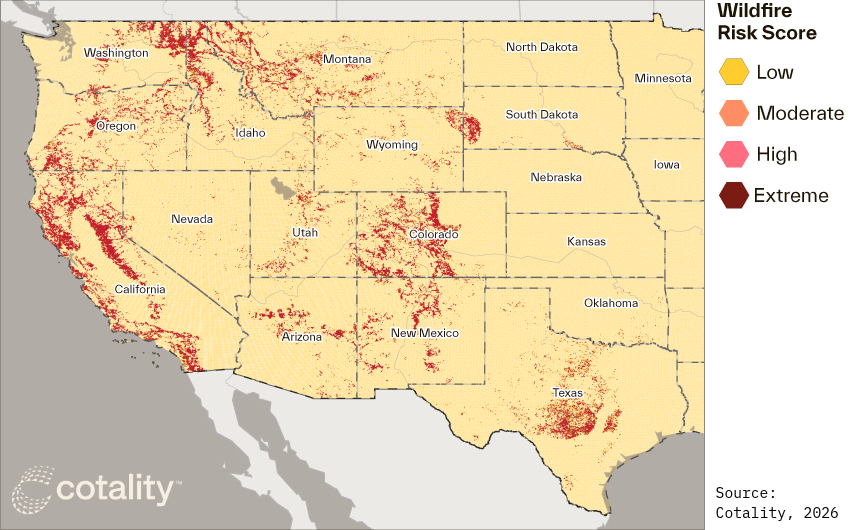
How conflagration reshapes what risk models miss
Cotality's analysis places particular emphasis on conflagration — the mechanism by which fire transitions from wildland into a neighborhood's built environment, spreading structure to structure.
The firm's modeling finds that layering conflagration potential onto a standard wildfire risk score can add as many as 40 points, reclassifying properties that legacy maps had categorized as low risk.
The financial spread between prepared and unprepared properties is equally striking. Homes in the top 10% of Cotality's property-level mitigation score carry expected losses roughly 78% below the statewide average.
Those in the bottom 10% face more than 10 times that average, approximately $47 in expected loss for every $1 on the best-prepared homes, according to the report.
"Hearing that a property has a higher risk score than previously thought should not be thought of as a bad thing," said Jamie Knippen, director of hazard insights at Cotality.
"It shows that new data and analytic capabilities create an opportunity to protect properties more effectively in the evolving wildfire environment we're facing. This represents a significant opportunity for the entire market: it empowers carriers to move away from broad-brush risk assessments and safely expand their underwriting footprint, and actively rewards homeowners who invest in resilience."
California brokers have already restructured their origination workflows around insurance risk as these market conditions are making homeownership increasingly difficult across multiple states.
Damon Germanides, co-founder and broker at Insignia Mortgage in California, previously told Mortgage Professional America that California's home insurance crisis now has to be addressed at the very start of every transaction.
"We get on it early on in the loan process because we don't want the client to have sticker shock when they get their insurance quote, or it could jeopardize the loan because the traditional underwriting matrix for insurance doesn't work anymore," he said.
Stay updated with the freshest mortgage news. Get exclusive interviews, breaking news, and industry events in your inbox, and always be the first to know by subscribing to our FREE daily newsletter.


