
A construction boom nearly froze America's housing deficit in 2024

The worst may be behind us — at least for now.
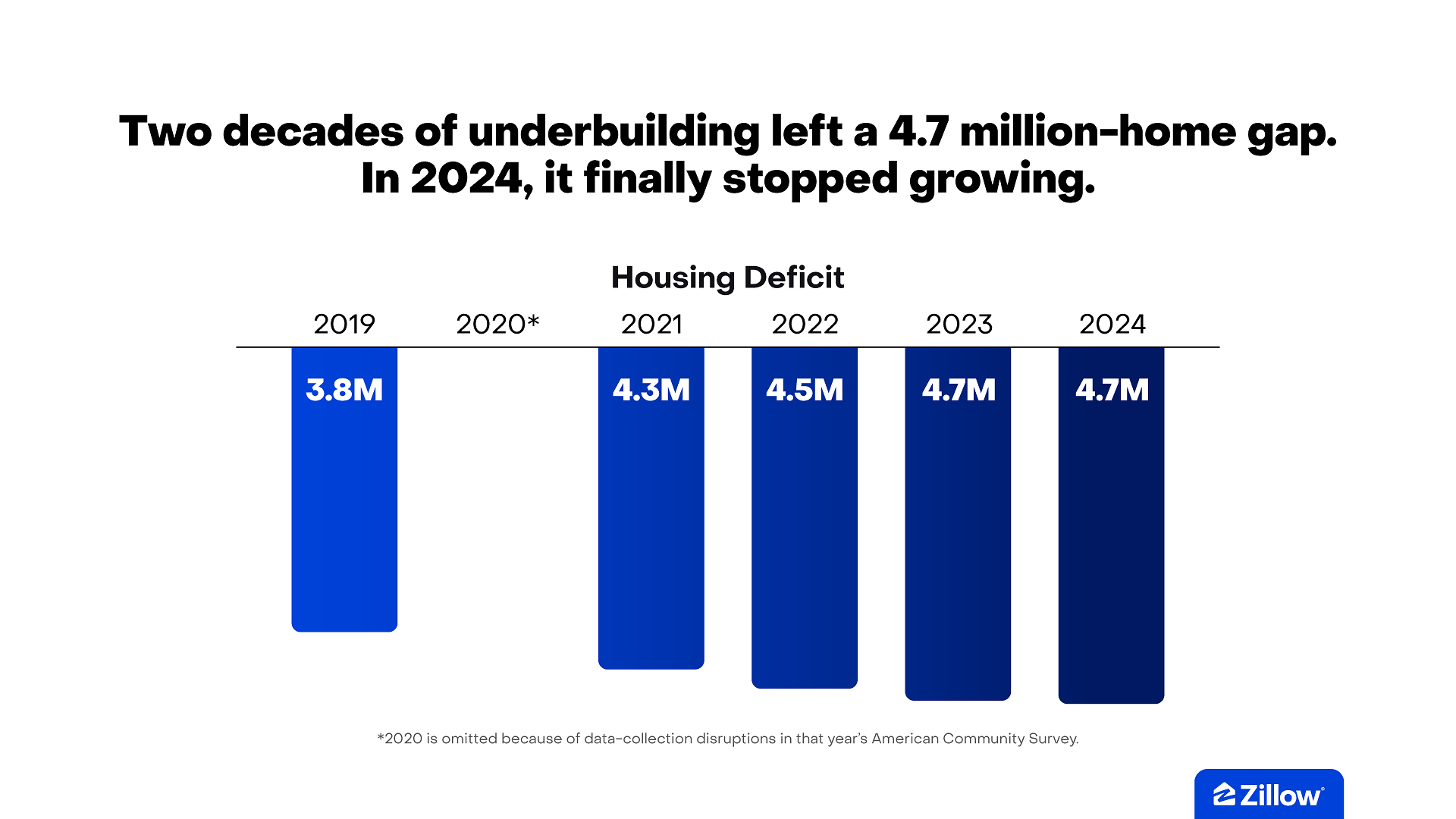
America's housing deficit held essentially flat in 2024 for the first time in years, expanding by just 43,000 units to a total of 4.74 million homes, according to new Zillow research based on recently released data from the US Census Bureau.
The figure marks a striking deceleration from annual increases of 257,000 units in 2022 and 159,000 units in 2023, and suggests that the country's most significant construction surge in decades may finally have stabilized the gap between housing supply and demand.
The 4.74 million-unit shortfall, rooted in nearly two decades of underbuilding that began after the 2008 financial crisis, remains the central force behind the nation's affordability crisis. But the rate of deterioration is now the smallest it has been in the current cycle.
"The country is not yet building its way out of the hole, but we stopped digging," said Orphe Divounguy, senior economist at Zillow, based in Seattle.
"Behind every missing home is a family doubling up, unable to find or afford a place of their own. Stopping the bleeding is progress, but making a real dent requires more than the status quo. We need flexible zoning to allow for more density, streamlined permitting and support for manufactured housing."
A building boom finally matched demand
The primary reason the deficit stabilized: builders delivered. The total US housing stock grew by approximately 1.4 million units in 2024, powered by newly finished multifamily buildings hitting a 50-year high.
For the first time in the post-crisis era, new supply and new household formation were roughly in balance, a milestone that had seemed out of reach as recently as 2022, when the deficit was widening at six times last year's pace.
The supply picture looks different depending on which number you focus on, however. While the total housing stock grew, the pool of homes actually available to rent or buy continued to shrink.
According to Census Bureau data analyzed by Zillow, available units fell from 4,047,268 in 2019 to just 3,429,528 in 2024, a decline of more than 617,000 units over five years.
For mortgage brokers, that contraction explains persistent inventory constraints even as new construction picked up. More than 8.17 million American families were doubling up in 2024, sharing a home with non-relatives when they would prefer a place of their own, up from 7.84 million in 2019.
Each represents a latent buyer or renter the market has yet to absorb.
Coastal markets remain a different story
Nationally, 35% of for-sale listings were affordable to a median-income household as of May 2026, defined as spending no more than 30% of gross income on the monthly mortgage payment, assuming a 20% down payment. That share improved from a trough of roughly 33% in 2023.
The recovery has been uneven, however. The five metros with the most severe deficits — New York, Los Angeles, Boston, San Francisco, and Washington, D.C. — saw affordable listing shares well below the national figure.
| Metro | Total available housing units |
Families doubling up in shared housing |
Families doubling up per available home |
|---|---|---|---|
| United States (national) | 3,429,528 | 8,172,802 | 2.4 |
| Boston, MA | 34,589 | 181,617 | 5.3 |
| San Diego, CA | 26,074 | 123,539 | 4.7 |
| Salt Lake City, UT | 11,286 | 46,962 | 4.2 |
| Portland, OR | 21,848 | 89,044 | 4.1 |
| Los Angeles, CA | 114,081 | 458,614 | 4.0 |
Source: Zillow analysis of U.S. Census Bureau data, July 2026. Available units = homes vacant and listed for sale or rent. National ratio derived from Zillow-reported totals. Metro rows ranked by families doubling up per available home.
Markets with lighter regulatory burdens responded faster to pandemic-era demand, helping prices and rents cool more quickly and rebalancing those markets ahead of higher-regulation counterparts.
Divounguy pointed to bipartisan congressional attention on the issue as a meaningful signal.
"It's been encouraging to see a bipartisan emphasis from Congress in finding solutions to the housing affordability crisis, because this is an issue that matters to everyone," he said.
Zoning reform, streamlined permitting, and expanded financing for manufactured housing remain the most widely supported levers for closing a gap of this scale.
Stay updated with the freshest mortgage news. Get exclusive interviews, breaking news, and industry events in your inbox, and always be the first to know by subscribing to our FREE daily newsletter.


