Rocket Mortgage data finds 25% of borrowers chip away at principal — and it's reshaping payoff timelines

A new analysis from Rocket Mortgage finds that making just one extra principal payment per year on a 30-year loan could save the typical US borrower roughly $68,000 in interest charges and cut nearly six years off their payoff timeline.
Rocket Mortgage examined voluntary principal contributions — payments applied directly to a loan's balance beyond the scheduled monthly installment — across its serviced portfolio from January 2021 through January 2026. About 25% of its clients make at least one such payment each year.
Aggregate contributions average the equivalent of one full additional monthly installment annually. Assuming a median loan amount of $221,977 at a rate of 6.67%, the weekly average as of Aug. 13, 2025, per Rocket, the typical borrower's monthly principal and interest payment runs around $1,425.
"For homeowners who have room in their budget and want to reduce debt, small additional principal payments can have a surprisingly meaningful impact over time," said Bill Banfield, Chief Business Officer at Rocket Mortgage.
"One simple approach is making the equivalent of one extra payment each year. On a 30-year mortgage, that can eliminate years of payments and save tens of thousands of dollars in interest."
For brokers advising clients on financial health beyond the close, the data offers a ready-made conversation framework. Switching to biweekly payments — which produces 13 monthly installments per year rather than 12 — is among the most accessible entry points for borrowers who want to replicate the effect without making large lump-sum contributions.
Rocket found that two additional payments annually can shorten a 30-year term by a full decade.
Mortgage applications for newly built homes slipped in July, with the Mortgage Bankers Association (MBA) reporting a 5.7% year-over-year decline and a 1% month-over-month drop.https://t.co/I2RiisWjyg
— Mortgage Professional America Magazine (@MPAMagazineUS) August 20, 2026
Rate era shapes who pays extra
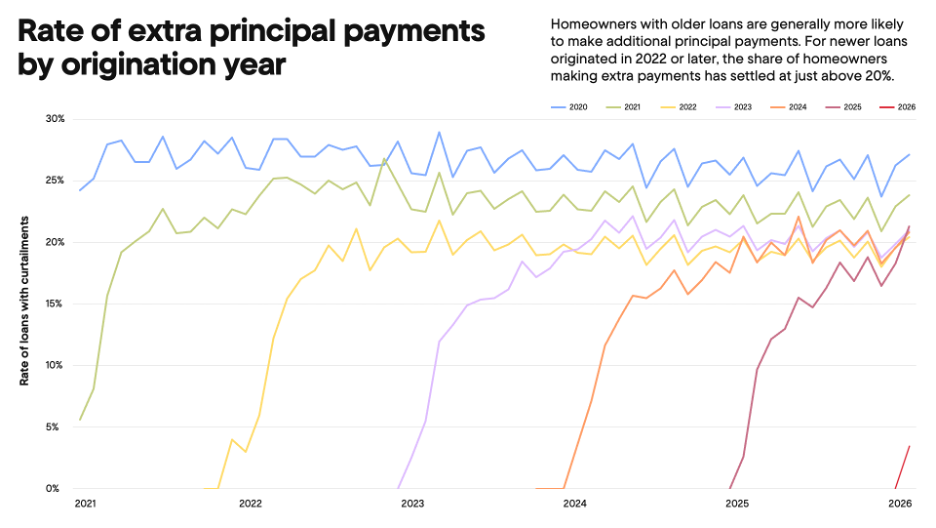
The analysis uncovers a behavioral divide tied directly to origination timing. Homeowners who secured ultra-low rates between 2020 and 2022 — when the 30-year fixed averaged near or below 3% for an extended period — are more likely to make extra principal contributions than those who entered the market after rates climbed.
The mechanism is straightforward: lower required monthly payments leave more discretionary cash to redirect toward the loan balance.
Borrowers who originated between 2023 and 2025 face a harder equation. Higher monthly obligations alongside elevated living costs push the extra-payment share for that cohort to just above 20%, roughly five percentage points below the study-wide average.
Yet when those borrowers do make additional contributions, their payments tend to be larger in absolute dollar terms, Rocket's data shows.
Early in the loan, the motivation is strongest
Across all rate environments, extra payments cluster most heavily at the beginning of the loan term. Banfield says the data points to the loan origination window as a meaningful inflection point for borrower intent.
"Our research found that homeowners who choose to make larger principal payments tend to do so earlier in the life of the loan," he said.
"This pattern includes those with ultra-low rates, suggesting the beginning of a mortgage may be an important moment when they are particularly focused on reducing debt and building equity."
That behavioral window has practical implications for originators. Brokers and loan officers who educate clients on principal reduction strategies at the point of origination may be better positioned to support long-term client retention as equity builds faster.
The findings arrive against a backdrop of sustained affordability strain.
According to the National Association of Home Builders (NAHB), in the second quarter of 2026 a household earning the national median family income of $106,800 would need to allocate 34% of wages toward monthly payments on a newly built median-priced home, up from 32% in the first quarter of 2026.
Housing is generally considered unaffordable once monthly costs exceed 28% of gross income. For existing homes, that share climbs to 36%, the NAHB reported.
Stay updated with the freshest mortgage news. Get exclusive interviews, breaking news, and industry events in your inbox, and always be the first to know by subscribing to our FREE daily newsletter.