Will the Fed raise rates for a second straight meeting, or will it push pause on a potential increase?

NOTE: This is a live blog that will be updated frequently. Refresh often for the latest updates.
That wraps up our live blog!
3:50 p.m. ET
That wraps up our live blog for this time, but it is not the end of our coverage.
Our Fergal McAlinden will have a story tomorrow with Melissa Cohn of William Raveis Mortgage to get her thoughts on the Fed's decision. He also spoke with Kristin O’Neil of Open Door Lending to get her thoughts on the decision to hold rates. And our Liezel Once has reaction from across the mortgage industry to the Fed announcement today.
Thank you all for joining us! We'll do it again on December 9.
My report on today’s Fed meeting
3:43 p.m. ET
Here is my quick video report on today’s Fed meeting
Warsh: Changes coming to Fed balance sheet early next year
3:35 p.m. ET
Fed Chair Kevin Warsh said recommendations on the Fed's balance sheet will probably reach the committee early next year, and that any change is unlikely to matter for policy right now.
A reporter asked how the Fed would avoid disrupting foreign holders of Treasuries if it shrinks the balance sheet further. The Fed also holds mortgage-backed securities, which is why changes there draw attention in the mortgage market, though Warsh didn't mention them in his answer.
"At this point, the balance sheet is solely within the four walls of the Balance Sheet Task Force," Warsh said. "I have checked in with them, full disclosure. They're working away and comparing their best thoughts. And I think the conclusions they come to, the recommendations they come to, will be fed into the FOMC probably early in the first quarter. But don't hold me exactly to that timing."
He said any change would come only after careful review. He added that the question is still worth getting to the bottom of.
"If we decide to make changes in the balance sheet, it'll be after a serious consideration of their proposals and their recommendations," Warsh said. "I think it is unlikely to have any material effect on this policy conjuncture."
Warsh also updated the Fed's five task forces overall. He had set them a year-end target.
"These five task forces are hard at work," Warsh said. "I gave them, like I told you, a year-end deadline. I think some but not all of the groups will probably hit their deadline and turn their homework in on time."
The Productivity and Jobs Task Force will hold a field hearing Nov. 16, and Warsh plans to attend. He expects it to run three to four hours and called it "pretty wonky stuff."
"Is this a productivity miracle that's going to happen, or will it happen slowly?" Warsh said. "I know I, for one, am keenly interested in refining my own views on that question."
Warsh on AI and rates: 'Interest rates get in the cracks'
3:32 p.m. ET
Fed Chair Kevin Warsh pushed back on the idea that AI investment is immune to higher interest rates, saying rates "get in the cracks" of almost everything.
A Financial Times reporter asked whether an economy driven by AI responds to rate increases the way a housing-driven one does. Warsh said he didn't buy the idea that AI investment is shielded.
"I was skeptical of that view," Warsh said. "Interest rates get in the cracks. Interest rates affect directly or indirectly almost everything."
He said investors have already shown it. Since early September, he said, they have become more selective about what they back.
"Interest rates have had an effect," Warsh said. "You see market participants that are discriminating between the kinds of investments they want to make. You've seen credit spreads for certain assets widen out, gap out. For others, you've seen some tightening in financial conditions, but not significantly."
He also challenged the idea that the economy's momentum is all about AI. He said the data since the last meeting back that up.
"It is convenient to say that the strength of the economy is all about this new technology wave," Warsh said. "In fact, if we look at the data, really including data from the last meeting till this, the CapEx story is not just robust, not just strong, but it is broadening. And so if you want to tell the story somehow that this is strength we're seeing only in narrow pockets, that's a much harder story to tell now than it would have been several quarters ago."
Warsh also laid out what the Fed is trying to achieve. He said the aim isn't a slowdown for its own sake.
"The goal, in my view, and you've heard me say this before, isn't to throw sand in the gears of the economy and throw people out of work," Warsh said. "I don't think we have to do that. The dominant means in which this policy is going to be put into practice is we are tightening financial conditions.
“They've tightened a bit since we met last time. That isn't something that we're uncomfortable with. That tells me that policy is working. And I think we can do that and make the economy more durable, have it last longer, and still achieve stable prices."
Warsh on oil and rates: 'I'm not a Wall Street newsletter'
3:27 p.m. ET
Fed Chair Kevin Warsh said market interest rates tracked oil prices higher for most of the year, then "rolled over to the downside" even as oil kept climbing.
Asked whether there is a direct line between oil prices and inflation, he said he would rather describe what he sees than speculate. His answer was about what markets have been doing.
"I don't want to engage in hypotheticals, but I can look out our window and see what's happened," Warsh said. "There'd been a stable correlation between oil prices as they've moved up this year, generally, and interest rates, not the interest rates that we control, but interest rates set in the market. That correlation has been quite strong."
Oil stayed elevated, he said, largely because of geopolitical events, and the gap between crude and refined products stayed wide. Rates, though, turned lower.
"Interest rates have rolled over to the downside," Warsh said. "I'm not a Wall Street newsletter. I'm just telling you, when I look out the window over the last several months, that is what we've seen."
That lines up with the mortgage market, where Freddie Mac's 30-year average slipped to 7.32% on Oct. 22 from 7.40% a week earlier. The 10-year Treasury yield has eased since peaking at 5.36% on Oct. 7.
Warsh declined to say what a drop in oil would mean for policy. He said it would be a question the Fed would have to examine.
"To the extent that oil prices were to move lower, again, probably due to geopolitical events, that's something that we're going to have to interrogate," Warsh said. "What are the effects on the Fed's dual mandate? What are the effects on financial market prices, and what are we going to do about it? But that's a hypothetical.
“And, in fact, if we look at financial market prices, futures prices for oil, they've moved up over the course of the last several weeks, and I can't help but take note of that too."
Warsh: 'I don't believe in forward guidance'
3:23 p.m. ET
Fed Chair Kevin Warsh wouldn't say whether December brings another increase. He told reporters he doesn't favor forward guidance in ordinary times.
Asked why the Fed didn't raise rates today, Warsh said price stability doesn't work on a schedule. He said the committee's first step after he arrived five months ago was to double down on its 2% target.
"Ensuring price stability, quashing inflation, is not about some fixed individual date on a calendar," Warsh said. "Same way it's not about some isolated data point. If it were about those two things, this job would be easier, and we wouldn't be suffering from nearly six years of inflation above target."
He acknowledged the Fed hasn't reached its goal yet. He pointed to September, when the committee acted.
"If the crux of your question is, you haven't delivered yet, you haven't achieved price stability, you're right about that," Warsh said. "But we're working on it."
An Associated Press reporter noted that the Fed's September projections penciled in another increase this year. Traders, meanwhile, were putting 76.5% odds on a funds rate 25 basis points above today's level after the December meeting, according to CME FedWatch as of Wednesday morning.
"I don't believe in forward guidance absent exigent circumstances, absent a crisis," Warsh said.
He said forward guidance was helpful in the worst days of the 2008 financial crisis. He doesn't see today as that kind of moment.
"In normal, ordinary times, especially times where the underlying real economy is this strong, I don't believe in it," Warsh said. "I don't favor it. I also don't believe in prejudging meetings. A lot of things can happen."
So he wouldn't preview what the committee will do in about six weeks. Other policymakers will be free to talk once their blackout period ends, which he thought would be Friday or over the weekend.
"I'm not going to be able to share with you my musings about what happens when this group gets together six weeks from now," Warsh said. "But my judgment is that we might learn a lot. And we'll be, I think, better positioned to determine the right policy decision and the stance of policy."
Warsh announces changes to meetings in ’27, ‘28
2:55 p.m. ET
The Fed is changing how it uses its meeting calendar. Chair Kevin Warsh announced Wednesday that some meetings will be set aside for strategy talks, starting in 2027.
"We've decided on a change in our FOMC schedule starting next fall," Warsh said. "We believe eight meetings per year is the right number for the FOMC. But in 2027, one meeting will focus exclusively on broad monetary policy strategy, with neither a vote on the federal funds rate nor a policy statement anticipated."
The rest of 2027's meetings will be regular policy-setting sessions, Warsh said, which works out to seven meetings with a rate decision. The split changes again in 2028.
"I expect that in 2028, we'll have two meetings dedicated to discussions of strategy and six for setting policy," Warsh said.
Warsh said the reasoning is simple. He framed it as a balance between the day-to-day and the long view.
"Getting policy right involves assessing near-term developments at timely, regular, and information-rich intervals," Warsh said. "But it's equally important we reserve time and space as an intellectually diverse group for strategic deliberations, for thinking anew about big questions, looking out over longer time horizons, focusing, as I say, on the left side of the decimal point.
"I believe the setting of the meeting schedule and agenda is more than some administrative detail. It's an institutional choice affecting the nature and the quality of our deliberations and ultimately the wisdom of our decisions. It's yet another change to get the conduct of monetary policy on the right track."
Warsh didn't say in his opening statement which 2027 meeting will be the strategy session.
Warsh: Inflation is 'too high'
2:51 p.m. ET
Fed chair Kevin Warsh said the central bank held rates steady Wednesday because, even as the economy keeps expanding, inflation is still too high.
"This morning, the FOMC decided to maintain the target rate for the federal funds rate at 3.75% to 4% in support of the Federal Reserve's dual mandate," Warsh said in his opening statement. "Economic activity is expanding at a strong pace."
Warsh said growth has strengthened, with first-half GDP revised up to 2.4% from 1.8%. The third quarter looks even faster, he said, led by consumer spending running above 3% and business investment rising at about a double-digit pace.
The jobs side of the mandate looks healthy too, he said, with the jobless rate lower than a year ago, payroll growth above last year's pace and unemployment claims at their lowest level in generations. Inflation was the sticking point.
It has run above the Fed's objective for close to six years, Warsh said. That is why the committee's discussion over the last couple of days focused mainly on price stability.
"Real activity is clearly pointing in the right direction," Warsh said. "That's good news. But inflation is too high."
Energy and related prices have moved higher again in recent weeks, he said. The Fed's job is to keep those price changes from spreading across the economy.
Since the Fed's September increase, he said, financial and credit conditions have tightened for some businesses and households, as the committee expected. Market participants, he said, are also becoming more discerning in how they allocate capital.
"While overall financial conditions are tighter, I'm unwilling and unable to call them tight," Warsh said.
Warsh, who became chairman five months ago, said uncertainty hasn't clouded the committee's purpose. He described his fellow policymakers as unambiguous in their commitment to stable prices.
"We've made clear our readiness to act as circumstances require, and we have shown our willingness to act," Warsh said. "The information we receive over the coming period will help us determine where we want policy to be."
Kevin Warsh’s comments
2:28 p.m. ET
Here is the link to the YouTube video where Warsh’s comments will air. We’ll transcribe his most notable comments here. Also, vote in our LinkedIn poll to let us know if you think the Fed made the right call today.
VOTE NOW: Did the Fed get it right? Vote in our poll now!
Lender perspective: It’s about the comments, not the move
2:25 p.m. ET
Charles Goodwin, vice president of investor mortgage sales at Kiavi, said he’ll be listening closely to what Fed chair Kevin Warsh has to say.
“The October decision matters less than the tone of the surrounding comments,” Goodwin said. “Short-term Treasury yields have already priced in a hike expected in either October or December. If the Fed holds but accompanies it with a hawkish tone, it could hurt mortgage rates more than a hold with softer language.
“With a hawkish tone, the 30yr mortgage rates would stay in the mid-7s or even increase further. If there is a hold but with a softer tone, for example referencing a softer jobs report, we might see a relief rally in yields.”
Goodwin is concerned that consumer sentiment is softening as inflation concerns are now being met with a weakening job market.
“In the private lending space, RTL volumes tend to correlate with existing home sales,” Goodwin said. “Higher rates generally translate to lower housing velocity and therefore lower volumes for RTL lenders. That being said, professional real estate investors have remained incredibly resilient through this period of higher rates, and RTL volumes have been minimally impacted.
“Private lenders as well as lenders in the Non-QM space have continued to see DSCR volume grow, as the DSCR product has gained steam over traditional ways of financing investment properties. I would expect DSCR volumes to remain strong even in this rate environment.”
Executive reaction: Schwab eyes December Fed move
2:20 p.m. ET
Omar Aguilar, CEO and chief investment officer of Schwab Asset Management, expects the Fed's next move to come in December after it kept rates unchanged Wednesday. He also sees a K-shaped housing market that will be challenging for mortgage brokers.
Aguilar spoke to Mortgage Professional America at Schwab IMPACT 2026 in Boston. He weighed in on the Fed's decision and on what it means for housing.
"Our expectation was that they're going to be pausing for now and their next move will likely be December," Aguilar said. "I think they're going to wait and see how much of the oil price can actually end up being less of an issue going into 2027."
He expects two more increases before the Fed pauses again, starting in December. CPI and PPI readings, he said, probably gave the central bank enough support for that move.
On housing, Aguilar sees the same split as the rest of the economy. At the top, he pointed to San Francisco and Texas, where newly public companies have created wealth and buyers often don't need a mortgage.
"We see the housing market also in a so-called K-shape, like everything else in the economy now," Aguilar said. "On the one hand, we've seen parts of the US market on the housing side that are starting to just become hotter than they were before despite the mortgage rates."
At the bottom of the K, he said, new entrants face less construction and fewer chances to buy. Inventory is the other problem.
"Yes, at 7%, mortgage rates, it's very hard," Aguilar said. "And then what happens is the inventory will just continue to collapse because a lot of people will not sell their house. Because they're already living on mortgage numbers that are in the 2% to 3%."
For brokers, the lower leg of the K is the hard part, he said, and the labor market is what to watch. He called it stable for now.
"That's definitely going to be challenging for two reasons," Aguilar said. "One is inventory is going to be fairly slow, and then second, the origination of new mortgages will be challenged."
Lender perspective: Seeming lack of urgency from FOMC
2:15 p.m. ET
Kurt Funderburg, chief investment officer of Byline Bank, was unsurprised by the Fed’s decision to hold rates steady today.
“Recent rhetoric from FOMC members points to a committee that feels little urgency to move again now,” Funderburg said. “Still, commentary indicates the FOMC is not done hiking and sees addressing ongoing inflationary pressures as a top priority. At the September meeting, 16 of 18 participants projected at least one more hike in 2026.”
The combination of oil prices on the current inflation picture and the growing investment in AI gives the Fed things to consider moving forward.
“The debate will be about how broad inflationary pressure has become,” Funderburg said. “A key to the debate will be whether inflation is mainly a supply-side issue driven by oil and other commodities coming out of the Middle East or whether the AI infrastructure boom is also driving demand-side price pressure.”
He said he’ll be watching Warsh’s tone in the post-announcement press conference, whether anyone dissented, the language used in the statement, and what the bond market does in the aftermath.
Lender reaction: Keep an eye on the bond market
2:10 p.m. ET
Now that the Fed has made its call, all eyes will be on the bond market, not only today but over the next few weeks.
Ryan Hayes, head of retail sales at Chase Home Lending, said rates will likely continue in a similar range that they’ve been in lately.
“The big story for mortgage rates in the weeks ahead will be how incoming inflation and labor-market data shapes longer-term Treasury yields,” Hayes said. “Importantly, a Fed decision doesn’t automatically translate into an equal move in mortgage rates because markets often price policy expectations well in advance.
“After some recent relief from October highs, I expect mortgage rates to remain range-bound and choppy near term, reacting quickly to economic data and shifts in risk sentiment. If the data confirms a cooling trend, rates could drift modestly lower at times, but borrowers should be prepared for ongoing volatility.”
Hayes is also keeping an eye on where inflation moves and the results of the midterm elections, both factors which could impact Treasury yields.
“Additional factors that could impact mortgage rates in November include shifts in inflation expectations, outcomes of the midterm election and changes in bond supply coming to the market - specifically from large AI hyperscalers that have been competing for investor demand,” Hayes said.
For brokers and originators looking for how to navigate this stretch after the Fed decision, Erik Schmitt, head of consumer direct sales at Chase Home Lending, said it’s about finding the right mortgage for your customer.
“The ‘right mortgage’ is the one that fits the borrower’s goals, and there isn’t a single best option for everyone,” Schmitt said. “The primary focus should be securing a loan with an affordable and sustainable monthly payment. Buyers may have more flexibility than they expect when it comes to loan options, low down-payment approaches, grants and potential discounts.”
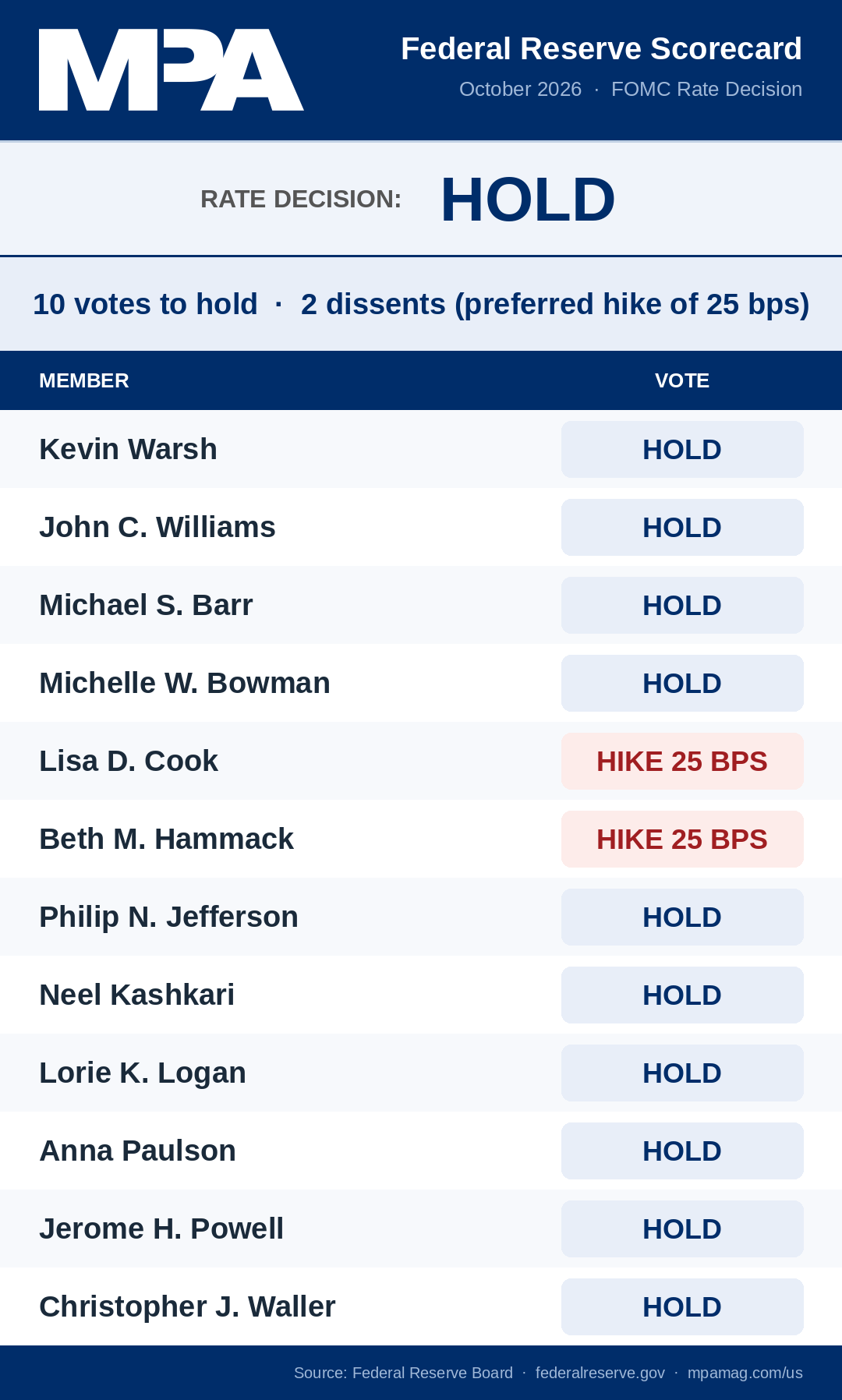
How they voted: A 10-2 decision for a hold
2:07 p.m. ET
The Fed was not unanimous on this rate decision. Two members of the Fed, Lisa Cook and Beth Hammack, voted for a 25 basis point rate hike.
See the chart below for the breakdown:
Breaking: Fed announces rate decision: It's a hold
2:00 p.m. ET
The Federal Reserve has officially announced its rate decision. It has decided to keep its fed funds target rate steady at 3.75% to 4.00%, after raising rates by 25 basis points at its last meeting.
The vote was 10-2, with Lisa Cook and Beth Hammack voting for a 25 basis point rate hike instead.
Fed chair Kevin Warsh will discuss the decision coming up at 2:30 p.m. ET. You can watch his press conference at the link below.
More predictions: A hold is expected
1:50 p.m. ET
Most mortgage professionals are expecting the Fed to hold rates steady today. That includes Jay Lessard, president of Sonoran Lending, but he told our Fergal McAlinden that he’ll be listening closely to Warsh’s comments.
“I’m expecting the Fed to hold rates steady today,” Lessard told Mortgage Professional America. “For me, the bigger story isn’t necessarily the decision itself, but the language that comes with it and what the Fed signals about December and the path forward.”
Lessard noted that the Fed is now having to deal with trouble on both sides of its mandate.
“Inflation is still running hotter than the Fed would like, so I don't think they're in a position to declare victory,” he said. “At the same time, there are signs of slower hiring and some moderation in parts of the economy. That gives the Fed a reason to be patient rather than continuing to raise rates at every meeting.”
The last time the Fed held rates, the bond markets weren’t crazy about it. Lessard will be keeping a close eye on the market.
“From a mortgage perspective, I'll be paying particularly close attention to how the bond market reacts to the Fed's message,” he said. “Mortgage rates don't move directly with the Fed funds rate, and sometimes the market's reaction to what the Fed says about the future is more important than the actual rate decision. The next day or two will likely be a bumpy ride.”
Jessica Eddy, loan officer at Edge Home Finance, also expects a hold today, but told McAlinden that she is concerned that Warsh’s comments may set off the bond market.
“I’m thinking they will hold,” Eddy told Mortgage Professional America. “The one to look for is the December meeting. Traders are putting a 75% chance on a quarter-point hike then. That being said, the main thing today will be Kevin Warsh's comments after the decision. That could bring volatility to the market.
“It’s worth remembering the Fed's fund rate isn’t the mortgage rate, so today’s decision alone won’t move mortgage rates. In addition, we are watching the 10-year Treasury more closely than the Fed announcement because that is also what mortgage rates follow.”
Coming up, the Fed’s decision at the top of the hour.
North of the border: A 25-basis-point hike
1:40 p.m. ET
The Bank of Canada raised its overnight rate target by 25 basis points to 2.5% on Wednesday, its first increase since July 2023. The Bank Rate moves to 2.75% and the deposit rate to 2.45%.
Governor Tiff Macklem pointed to energy prices, with the war in the Middle East now in its eighth month and no clear path to resolution. The inflation outlook has worsened since the Bank's July report.
"First, the outlook for inflation has deteriorated," Macklem said at the Bank's press conference. "With the war in the Middle East persisting, global oil prices have increased and are expected to remain higher for longer. This is hitting Canadians at the gas pump and increasing costs for many businesses."
Inflation has hovered around 3% since April, and the Bank expects it to climb to roughly 3.5% by the end of the year. Strip out gasoline, and it was 2.2% in September.
The economy has held up better than expected, with GDP up 3.3% in the second quarter, though the Bank expects housing to remain relatively weak. That left Governing Council weighing a hold, backed by core inflation near 2%, slack in the economy, and new US tariffs, against an increase, backed by energy costs working their way into other prices.
"With the outlook for inflation substantially higher and the economy showing resilience, an increase in the policy rate is needed to reduce the risk that elevated energy prices could spill over and become generalized inflation," Macklem said.
The Bank left the door open to more potential hikes. Its next decision is Dec. 9.
"Looking ahead, Governing Council agreed we would take future decisions one meeting at a time," Macklem said. "There could be a need to raise the policy rate further, but given the uncertainties, we will proceed carefully."
The Federal Reserve announces its own decision at 2 p.m. Eastern today. It raised rates for the first time since 2023 about six weeks ago.
Lender reaction: Dual mandate focus hurts Fed, market
1:30 p.m. ET
Fairview Commercial Lending COO and partner Glen Weinberg is never short of a strong opinion about mortgage topics. He’s been in the industry for more than 30 years, so he brings a lot of experience behind those opinions.
He believes the Fed focusing on both employment and inflation is a hindrance, rather than a positive for the market.
"This dual mandate was the worst thing the Federal Reserve could do," Weinberg told Mortgage Professional America.
Congress amended the Federal Reserve Act in 1977 to direct the Fed to promote maximum employment, stable prices, and moderate long-term interest rates. However, critics have been skeptical of jobs data, and that’s just one of the reasons Weinberg argues the Fed should act on inflation alone.
"All they need to do is focus on their one thing, inflation, because as soon as they start focusing on employment, they aren't taking the right steps for inflation," he said.
He agreed with the premise that if the weaker jobs report hadn’t come out a few weeks ago, the central bank would likely be looking at another rate hike today.
"So, the Fed is going to create this problem in this cycle because they're worried about employment," he said. "Employment should have nothing to do with their decisions. It should be inflation and the long-term stability of the economy. But as soon as you get out of your box, nothing happens. That's why we're stuck.
He believes that the criticisms of the jobs data, which is often revised after the fact, just add to the argument that the Fed should be hyper-focused on inflation.
"It's based on a survey. It's like, okay, if anybody calls me, hey, I want to do a survey, do you answer the phone? Absolutely not," he said. "I'm not answering the phone. Why? Random number asking me for a survey? I mean, they don't even get through my Google phone. It's like, so their information is garbage as well."
While we’re waiting to see what happens, here’s a chart of the Fed funds rate since 2010. This reflects the actual overnight funds rate rather than the range that the central bank operates within.
Comparing US rates to the rest of the world
1:20 p.m. ET
Here is a chart and an interactive map showing how the US Federal Funds rate compares to central bank rates around the world:
| Country | Central Bank Rate |
|---|---|
| Switzerland | 0.00% |
| Singapore | 1.05% |
| Japan | 1.25% |
| Canada | 2.50% |
| Eurozone | 2.65% |
| China | 3.00% |
| South Korea | 3.00% |
| United States | 3.75% – 4.00% |
| United Kingdom | 3.75% |
| Saudi Arabia | 4.50% |
| Australia | 4.60% |
| India | 5.50% |
| Indonesia | 5.75% |
| Mexico | 6.50% |
| South Africa | 7.25% |
| Brazil | 13.75% |
| Russia | 14.00% |
| Argentina | 29.00% |
| Türkiye | 36.00% |
Fed Preview: Conflicting mandates likely bring a hold
1:00 p.m. ET
Sam Williamson, senior economist at First American, believes the central bank will pause this afternoon rather than hike rates for a second straight meeting, with both sides of its dual mandate struggling.
"Election day may command the headlines, but the economic data will ultimately drive the Fed's next move," Williamson told Mortgage Professional America. "And in September, the data painted a mixed picture, with inflation coming in hotter than expected and job growth surprising to the downside. While an October rate hike remains a possibility, the Fed may prefer to proceed cautiously and wait until December."
As is often the case when the Fed holds, the post-decision press conference may be more interesting than the decision itself. Will Fed chair Kevin Warsh tip his hand about what’s to come in December, or will he continue to resist giving forward guidance?
Williamson said there could be dissent not just in how to tackle the current market, but how boldly to move.
"The Fed remains united on the goal of bringing inflation down, but not necessarily on how quickly to get there," he said. "As policymakers weigh persistent inflation against the risk of overtightening, differences over the timing and pace of further hikes could lead to more dissent in the months ahead."
Meanwhile, all eyes will be on the bond market in the post-meeting, which has been on a rollercoaster ride over the last few months. Williamson said that more volatility could be ahead.
"Treasury yields may have retreated from their recent highs, but the forces pushing them higher have not," Williamson said. "Stubborn inflation, resilient growth, and expectations for further Fed tightening will likely keep interest rates elevated through year-end. While oil prices and investor sentiment around AI stocks could create some bumps along the way, the broader trend heading into 2027 still points to a higher-for-longer interest-rate environment."
Welcome to the live blog!
12:45 p.m. ET
Welcome to our seventh live blog of 2026 at Mortgage Professional America. Today, we are covering the Federal Reserve’s October rate announcement.
The betting markets believe more rate hikes are in the future for the Fed, but not today. There is a strong expectation of a rate hold at today’s announcement. The last time the Fed held, the bond market spiked, so we’ll see what the markets think of the Fed’s announcement this afternoon.
Then, all eyes will turn to the midterm elections next Tuesday and the final Fed meeting in December.
We'll be previewing the decision here until 2 pm ET, when we'll have the official word from the Fed. Then we'll bring you industry reaction and Fed chair Kevin Warsh's thoughts afterwards.
Refresh often for the latest from our live blog!