Cotality’s September data shows national prices up 1.7%

Single-family home prices in the United States rose 1.7% year over year in September, but slipped 0.3% from August, according to Cotality, the Irvine, California-based property information and analytics firm.
The company now forecasts that annual home price growth will slow further to 0.9% by September 2027, with the national median already above $400,000.
The September data points to a market that is splitting rather than correcting. Elevated mortgage rates continue to suppress buyer activity, but persistent inventory shortages in parts of the country are keeping prices from falling outright.
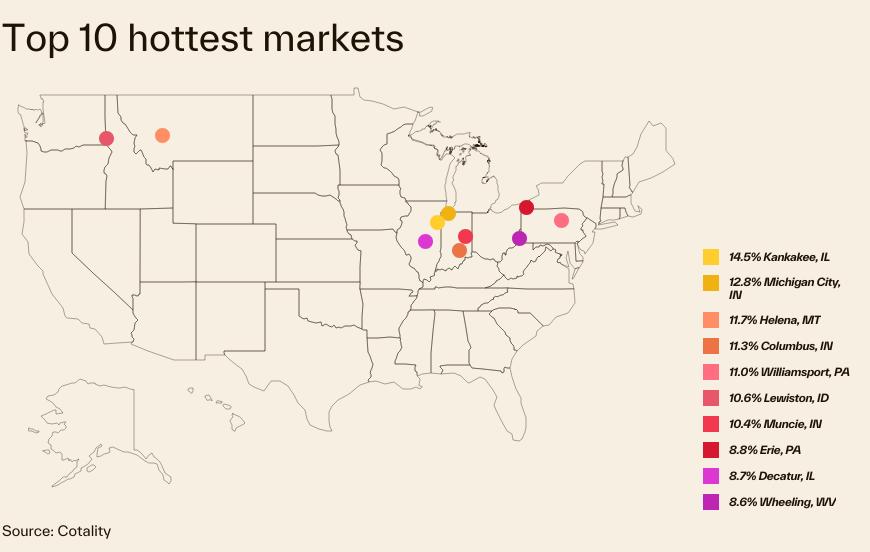
Appreciation strengthened in roughly half of major metros from August to September while weakening in the other half, leaving brokers without a single national narrative to bring to clients.
Rising mortgage rates are on track to overwhelm the US housing shortage in 2027, suppressing both home sales and new construction, according to Goldman Sachs Research. https://t.co/K98uS5esUX
— Mortgage Professional America Magazine (@MPAMagazineUS) November 2, 2026
Northeast and Great Lakes lead while Sunbelt struggles
Annual gains were concentrated in states where chronic undersupply has collided with relative affordability. Illinois led with 6.9% year-over-year growth, followed by Rhode Island (6.4%), Connecticut (6.0%), New Jersey (5.1%), and Ohio (4.9%).
Accelerating metro markets included Cleveland, Albany, N.Y., Providence, R.I.-Mass., Greensboro, N.C., and St. Louis, Mo.-Ill. — markets where job growth, in-migration, and recent price resets have reinforced demand.
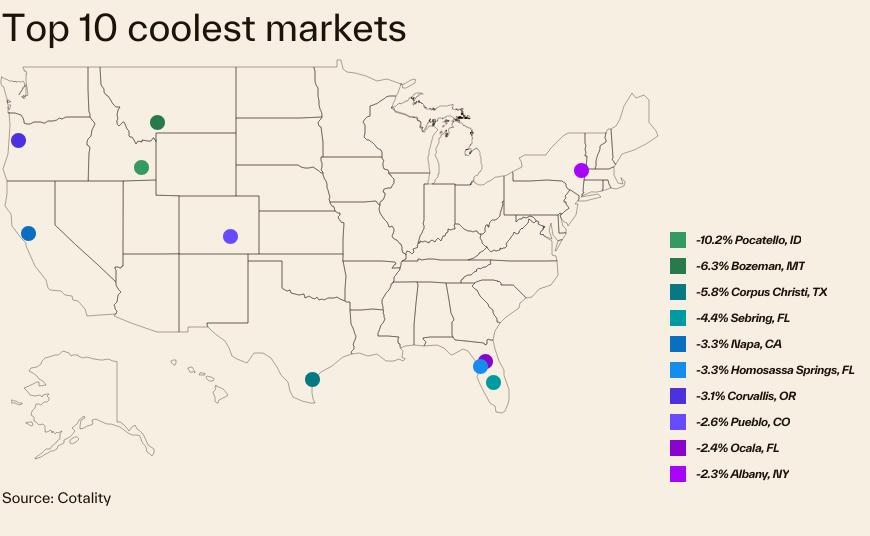
Resource-dependent and former pandemic boom states tell a different story. Washington fell 1.0% year over year, Wyoming declined 0.7%, and Texas dropped 0.4%, with Hawaii and Utah posting slight losses.
Six states in total recorded negative annual appreciation.
Cotality’s Market Risk Indicators identify the following as the five markets most at risk of price declines over the next 12 months:
- Buffalo-Cheektowaga, N.Y.
- Cambridge-Newton-Framingham, Mass.
- Providence-Warwick, R.I.-Mass.
- Tacoma-Lakewood, Wash.
- Worcester, Mass.
What the data means for brokers heading into 2027
“Elevated mortgage rates are expected to limit home buying opportunities in 2027,” said Dr. Selma Hepp, Chief Economist at Cotality.
“However, more inventory and greater buyer bargaining power will keep home price growth subdued, improving affordability. Market activity will favor regions with solid economic prospects, regions that attract retiring population and offer affordable homes.”
When the 30-year fixed rate climbed from 6.5% to 7.5%, the monthly payment on a median-priced home jumped by approximately $300, pushing the annual income required to qualify to $103,000 nationally.
In California, where the median sits at $754,500, buyers need an annual income of roughly $180,900.
In Florida and Texas, where the median is approximately $369,750, higher insurance and property tax costs often push total carrying costs above practical borrowing limits, a dynamic Cotality identifies as driving metro-level declines in markets such as Austin (-2.0%) and Dallas (-1.0%).
“Potential homebuyers are feeling the pinch from rising costs across the board, especially for daily living expenses,” said Dr. Hepp.
“Meanwhile, limited job opportunities and slow wage growth are making households reluctant to move.”
The view is consistent with what senior economists have told this publication. Mike Fratantoni, chief economist and senior vice president of research at the Mortgage Bankers Association (MBA) in Washington, DC, told Mortgage Professional America in his 2026 forecast: “I think the affordability situation is going to get moderately better over the next couple of years. We expect that wages are going to be growing faster than rents, and going to be growing faster than home prices. So that, in combination with mortgage rates staying stable, should make it slightly easier over time for folks to afford that housing payment.”
For brokers advising clients in cooling markets, the central point is that rising rates have not triggered national price declines — supply constraints are still holding floors in undersupplied regions.
Thirteen states reached new price highs in September, even as the national trajectory continues to bend lower.
Stay updated with the freshest mortgage news. Get exclusive interviews, breaking news, and industry events in your inbox, and always be the first to know by subscribing to our FREE daily newsletter.