
New data reveals the US cities giving first-time buyers the best shot at rental-offset homeownership

As the traditional starter home slips further out of reach for many Americans, a growing number of first-time buyers is bypassing conventional single-family ownership entirely — and new market data shows which cities give that alternative strategy the best odds.
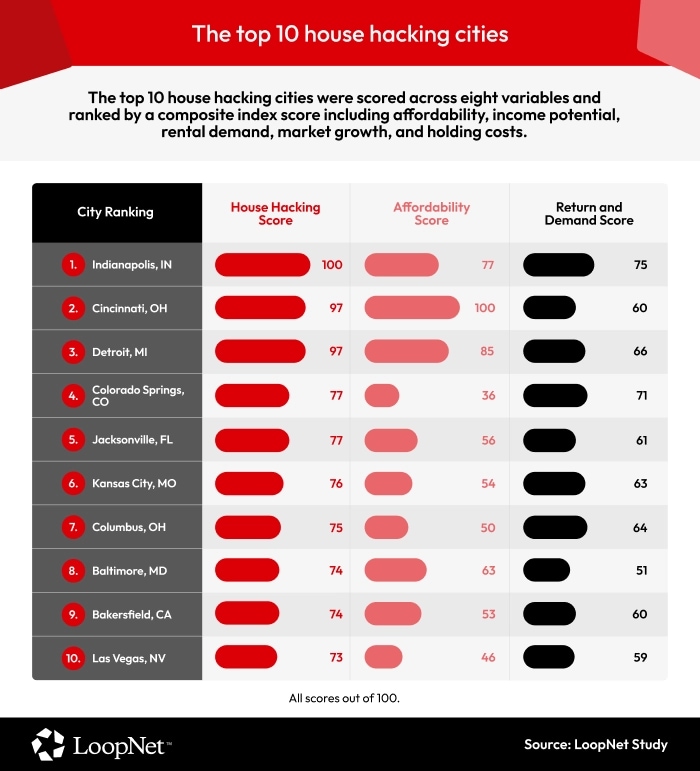
LoopNet's 2026 House Hacking Index scored 50 US cities across eight variables including affordability, estimated gross yield, vacancy rates, and Federal Housing Administration (FHA) financing accessibility.
The Midwest and Rust Belt dominated the results, claiming five of the top seven spots.
House hacking — buying a duplex, triplex, or fourplex, living in one unit, and renting out the others to offset housing costs — has become an increasingly visible strategy as first-time buyers seek unconventional paths to ownership.
Because the buyer lives on-site, lenders classify the purchase as a primary residence, unlocking owner-occupant programs like FHA loans, which require as little as 3.5% down.
Midwest cities lead the house hacking rankings
Indianapolis, Indiana, claimed the top overall spot with a median price of $124,750 per unit and an estimated gross yield of 15.28%, the highest in the study.
A 4.1% vacancy rate added strong marks on rental demand, giving the city an advantage across multiple scoring categories simultaneously.
For brokers tracking where first-time homebuyers are finding affordable markets in 2026, Indianapolis's profile cuts across every dimension that matters.
Cincinnati, Ohio, ranked second on the strength of its financing accessibility. The city's FHA four-unit loan limit of $1,041,125 covers more than four times the median multifamily listing price of $82,917 per unit, the lowest entry cost in the top five.
Detroit, Michigan, followed in third place with an estimated gross yield of 14.3% and FHA coverage reaching 3.8 times the median listing price.
Two non-Midwest markets also broke into the top five. Colorado Springs, Colorado, ranked fourth on a combination of an 8% gross yield and a 3% vacancy rate, one of the lowest in the entire index.
Jacksonville, Florida, completed the top five with an 11% estimated gross yield and 7% five-year population growth, though its 11% vacancy rate is a variable brokers should factor carefully into client cash flow projections.
A strategy already on brokers' radar
The growing appeal of house hacking as a first-time buyer entry point has been a recurring theme in conversations between loan officers and affordability-squeezed clients.
Graham Nadler, senior loan officer at Ruoff Mortgage in Columbus, Ohio, told Mortgage Professional America in January 2025 that FHA-backed multifamily purchases remain one of the most underutilized entry points in today's market.
"It's probably the cheapest money you'll ever get," Nadler said.
"With FHA loans, you can get in with 3.5% down, and Fannie Mae just announced 5% down for owner-occupied multifamily units. That's a huge opportunity for people starting out."
That kind of creative entry strategy feeds into a broader expectation reset that brokers are navigating across the market.
Matt Gouge, mortgage broker and founding partner at UMortgage, told MPA that first-time buyers need to recalibrate what an initial purchase is actually meant to accomplish.
"Buyers, especially first-time homebuyers, have to be a little bit more flexible," Gouge said.
"They have to start thinking about housing, especially their first house, as a stepping stone, not a forever home."
LoopNet's methodology draws on active listings as of May, US Census Bureau American Community Survey data, US Department of Housing and Urban Development (HUD) FHA loan limits for 2026, Tax Foundation effective property tax rates, and the LSC Eviction Laws Database.
Stay updated with the freshest mortgage news. Get exclusive interviews, breaking news, and industry events in your inbox, and always be the first to know by subscribing to our FREE daily newsletter.


