
Rents fell for a third straight month, with supply outpacing demand in key markets

United States apartment rents fell for the third month in a row in September, dropping 0.3% to an average of $1,712, according to Apartments.com and CoStar Group. This was the steepest September decline in more than 15 years and highlights a wider slowdown in the multifamily market.
While rent growth typically slows in late summer and fall, the recent year-over-year deceleration signals a more pronounced softening. Annual rent growth slipped to 0.9% in September, down from 1.0% in August and 1.5% at the start of 2025.
“The rent decline from peak levels through September 2025 is steeper than in 2024, both in absolute dollars and in percentage terms,” CoStar analysts wrote. “This year’s pullback exceeds typical seasonal patterns and reinforces the broader trend of moderation in rent growth.”
All regions posted rent declines last month. The West led with a 0.5% drop, followed by the South at 0.4%, the Northeast at 0.2%, and the Midwest at 0.1%.
On an annual basis, the Midwest outperformed with 2.4% growth, while the West fell 1.3%.
“Markets with the highest levels of new construction are seeing the weakest rent performance, while more supply-constrained metros—particularly in the Midwest and select coastal areas—continue to outperform,” CoStar said.
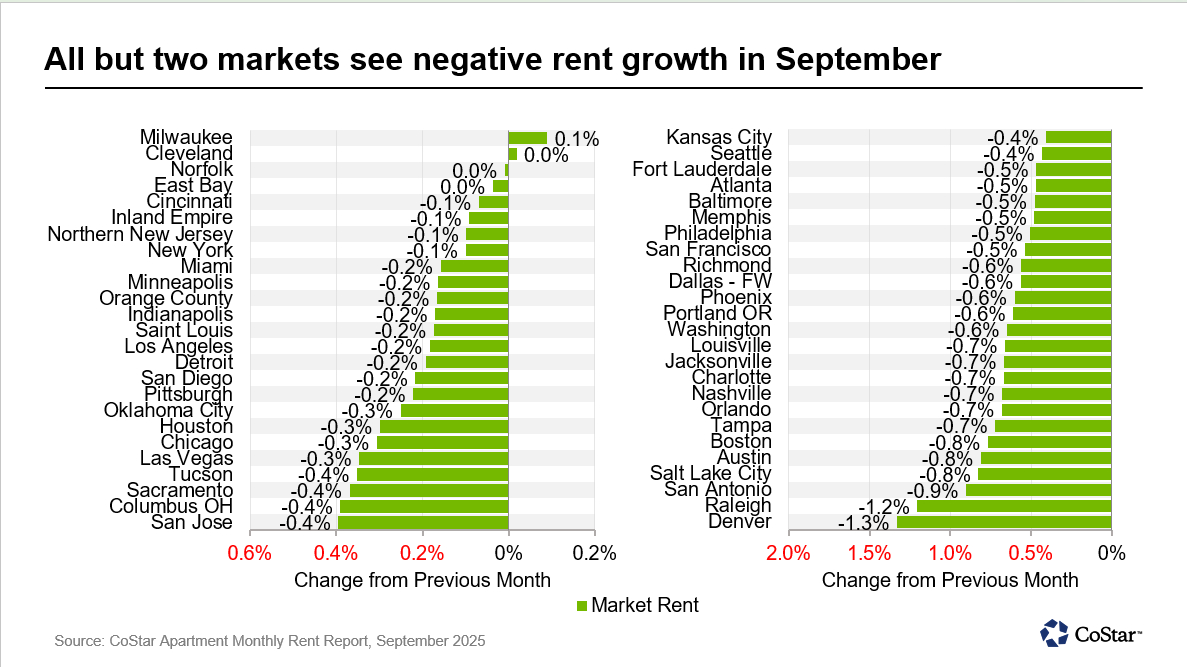
Metro-level softness was widespread. Only Milwaukee (+0.1%) and Cleveland (+0.02%) posted monthly rent gains.
Denver (-1.3%), Raleigh (-1.2%), San Antonio (-0.9%), and Salt Lake City (-0.8%) saw the steepest monthly declines, with analysts attributing the weakness to “elevated vacancy amid aggressive new supply.”
San Francisco led the nation in annual rent growth at 6.1%, followed by San Jose and Chicago (both 3.8%).
In contrast, Austin (-4.4%), Denver (-3.8%), and Phoenix and San Antonio (both -2.9%) posted the largest annual declines, as oversupply continued to outpace demand.
The September data highlight the delicate balance of rent growth as the fourth quarter begins. While the national average remains above last year’s levels, a substantial inventory overhang continues to weigh on momentum.
Persistent supply pressures could keep rent growth subdued into 2026, with potential ripple effects for multifamily lending and property valuations.
Stay updated with the freshest mortgage news. Get exclusive interviews, breaking news, and industry events in your inbox, and always be the first to know by subscribing to our FREE daily newsletter.


