
Inventory and buying power improved, but new listings still held the spring market back

Existing‑home sales opened 2026 on a soft note, even as affordability and inventory improved from last year.
For First American deputy chief economist Odeta Kushi, the coming spring selling season still looked more promising than 2025 – but only if more owners finally chose to list.
January’s sales pace, at about 3.9 million annualized, marked the weakest reading in more than two years, with the National Association of Realtors blaming an 8.4% month‑over‑month drop partly on harsh winter weather and lingering affordability strain.
Inventory, though, edged 3.4% higher than a year earlier, to roughly 1.22 million homes for sale, suggesting more choice than buyers had in 2025.
“One of the most encouraging signals heading into the spring home‑buying season is the improvement in for‑sale inventory levels compared with last year. For‑sale inventory in January was approximately 9 percent higher than a year ago – a meaningful shift in a market long defined by limited supply,” Kushi said.
“More homes on the market give buyers greater choice and, combined with improved buying power, expand the range of homes they can realistically consider. After all, buyers can’t purchase what’s not for sale. A broader selection of available homes will typically fuel stronger sales activity.”
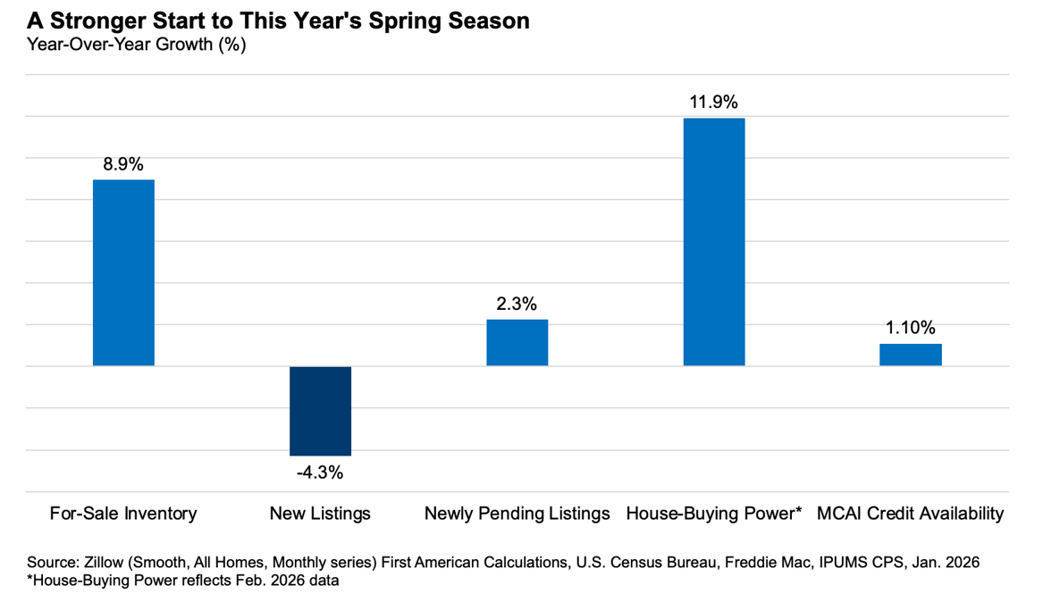
Kushi added that “prospective home buyers will also benefit from improving house‑buying power, which is up 12 percent compared with a year ago.”
“An uptick in new listings remains this missing ingredient to jumpstart the spring home‑buying season,” Kushi said.
“New listings were 4 percent lower than a year ago in January. Our research consistently shows that new listings are the lifeblood of the housing market. While rising for‑sale inventory may reflect homes staying on the market slightly longer, it is new listings that drive sales volume. Without more homeowners deciding to sell, the market’s recovery will remain measured, rather than robust.”
Credit conditions added another modest tailwind. The Mortgage Bankers Association’s Mortgage Credit Availability Index rose 1.1% in January to 105.9, reversing December’s pullback.
“Mortgage credit availability increased in January, as lenders broadened their offerings of ARM loans, cash‑out refinances, and loans on second homes,” MBA vice president and deputy chief economist Joel Kan said.
The bigger question for lenders and originators this spring is what would happen when still‑strong demographic demand meets only gradually improving supply.
If more would‑be movers finally stepped off the sidelines, Kushi argued, existing‑home sales could regain momentum as rising house‑buying power and looser credit meet long‑deferred life‑cycle moves.
If they did not, 2026 risks looking less like a breakout year and more like another slow grind in a market where demand is ready, but too few owners are ready to sell.
Stay updated with the freshest mortgage news. Get exclusive interviews, breaking news, and industry events in your inbox, and always be the first to know by subscribing to our FREE daily newsletter.


