Economists say great restaurants get priced into the homes around them. In resort towns, the effect is bigger, and so is the risk.

In a ski town or a beach village, talk about a house usually starts with the view and ends with how far it is to the lift or the sand. More and more, buyers ask a third question before they get to financing: where do we eat?
It's a better question than it sounds. A growing body of economic research suggests that restaurants, especially good ones, get priced into nearby homes, and that the benefit spreads to the shops, bars and galleries next door. For mortgage professionals working vacation markets, where second-home lending just posted its first annual gain since 2021, the local dining scene is starting to look less like a lifestyle perk and more like a market signal.
What the research shows
Some of the best-known evidence comes out of Harvard. In a working paper published by the National Bureau of Economic Research, economists Edward Glaeser, Hyunjin Kim and Michael Luca paired Yelp business listings with Census and Federal Housing Finance Agency data. They found that neighborhoods on the upswing added groceries, cafés, restaurants and bars without squeezing out other kinds of businesses. Shifts in the local business mix tended to show up before home prices moved, and each additional Starbucks in a ZIP code was associated with roughly a 0.5% rise in housing prices.
How good the food is matters too, not just how many places there are. In a study in the Journal of Urban Economics, economist Chun Kuang used Yelp ratings as a stand-in for restaurant quality. Kuang concluded that both the number and the caliber of nearby restaurants show up in home values. The premium was stronger once online reviews made quality easy for the public to see.
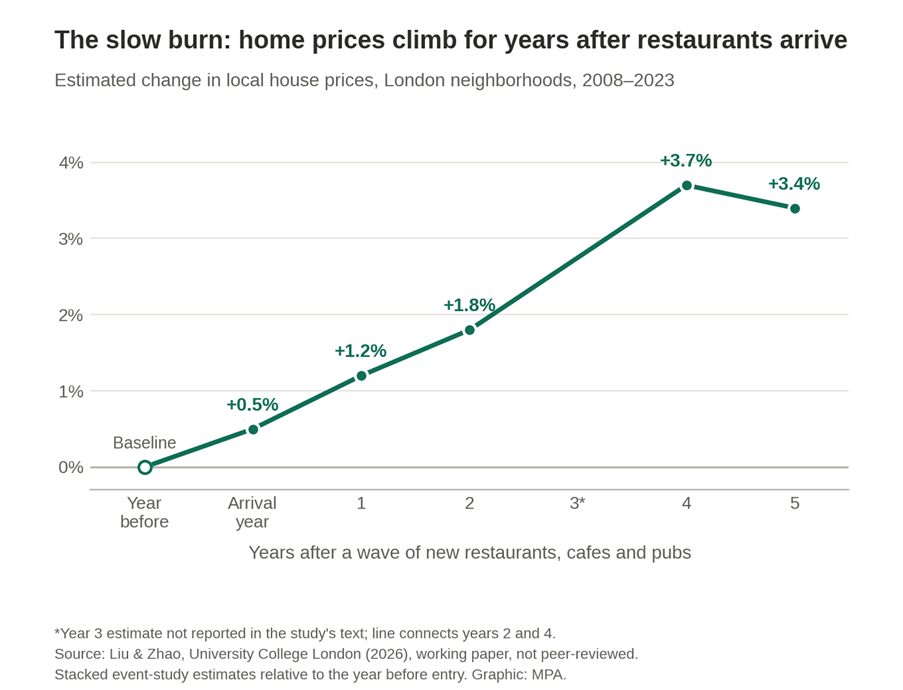
Newer work points the same way, but it suggests the effect takes time. A 2026 working paper from researchers at University College London, which has not yet been peer-reviewed, tracked London neighborhoods after clusters of food-and-drink businesses opened. Prices rose only about half a percent in the first year. Four to five years later, they were up roughly 3.4% to 3.7%.
Why resort towns feel it more
In a big city, a great restaurant is one amenity among thousands. In a town with a few thousand year-round residents, it can be part of the reason people visit at all.
Travelers already account for a big share of dining dollars. The National Restaurant Association estimates that in a typical year, about $3 of every $10 spent at U.S. restaurants comes from travelers and out-of-town visitors. It stands to reason that the share runs higher in tourism-driven economies, though national data don't break that out by resort market.
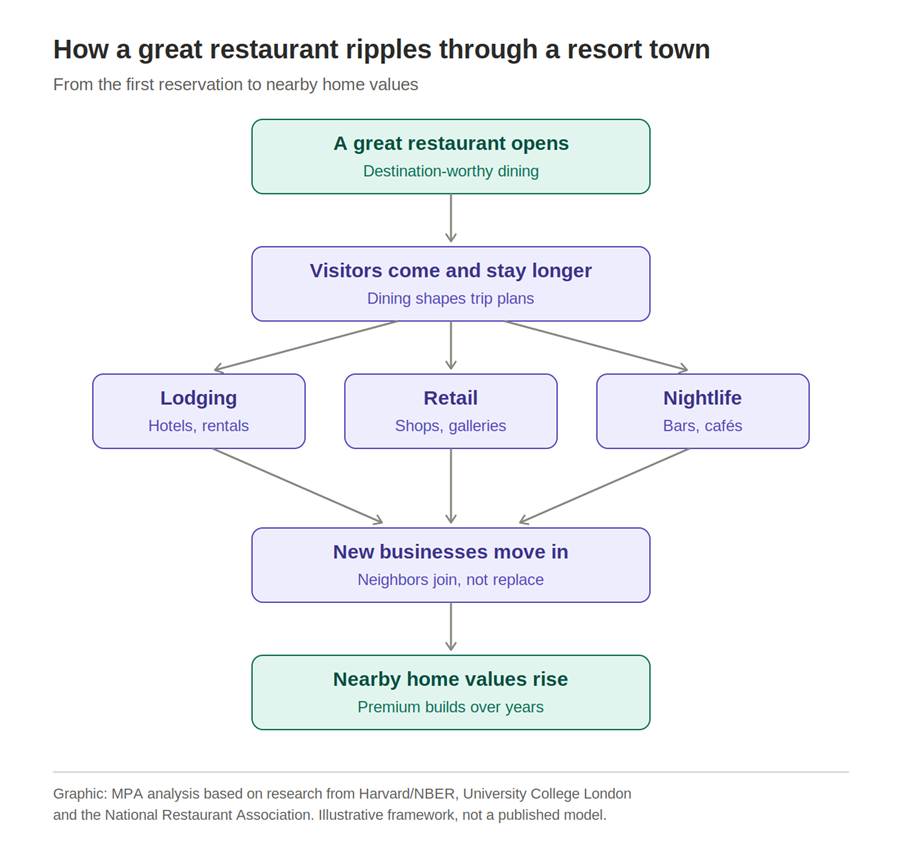
A visitor who comes for a tasting menu also books a room, rents gear, browses the boutiques and has a nightcap down the street. The Harvard team's finding that restaurants rarely crowd out other businesses fits that picture: good kitchens tend to attract neighbors rather than replace them.
Colorado shows how seriously resort towns take this. When the Michelin Guide arrived in the state in 2023, Aspen and Snowmass Village, along with Vail and Beaver Creek, were among the few areas inspectors covered. According to The Colorado Sun, each participating area agreed to pay between $70,000 and $100,000 a year for three years, alongside roughly $135,000 from the Colorado Tourism Office. In 2026, those deals gave way to a single statewide agreement. Tourism officials, in other words, are treating a restaurant guide as economic development spending.
The catch: somebody has to cook
This is the part that should matter most to anyone underwriting in a resort town. A dining scene is only as durable as its workforce, and in many vacation markets that workforce can't afford to live nearby.
In Colorado's mountain communities, worker shortages have forced restaurants to cut their hours. In the Florida Keys, NPR reported this summer on restaurant workers who serve tourists all day but can't afford to live in town. Near Telluride, the housing squeeze has become so acute that hotels are being converted to long-term worker housing as vacation rentals take over homes, sometimes ending up in court.
High-end dining is also financially fragile. Research by David Sands found that more than 40% of restaurants that had earned a Michelin star had closed by the end of 2019, compared with about one in five restaurants without one. Part of the reason is that recognition brings higher rents, wage demands and customer expectations.
So the amenity that props up a neighborhood's values can vanish. When it does, a small resort town loses more than a place to eat.
What it means for lenders and brokers
The practical takeaways for originators are more about judgment than formulas.
The buyer pool is small and wealthy. A Redfin analysis of federal mortgage data found that 85% of 2025 vacation-home mortgages went to high earners with a median income of roughly $294,000. The typical second home was valued at $515,000. These are buyers who shop for a lifestyle, and dining is part of it.
Amenity premiums build slowly. If the London findings hold, a buzzy new restaurant row doesn't justify stretching a valuation today. Appraisals rest on closed comparable sales, and those will lag any dining-driven lift.
Watch the help-wanted signs. Cut hours, shortened seasons or closures can be an early warning of the affordability strain that eventually shows up in the wider local economy. That includes the rental-income assumptions behind short-term rental loans.
Sell the story, not the forecast. It's fair to point out a thriving restaurant scene to a client. It isn't a basis for projecting appreciation.
Redfin's Chen Zhao has described the vacation-home rebound as unfolding in "a very different market than it was during the pandemic." That comes after second-home demand sank to its lowest level in nearly a decade. In that kind of market, the best restaurant in town is both a symptom of wealth and a magnet for it. The smart money watches the reservation book and the help-wanted sign.
Read next: Second-home buyers in short supply as market cooldown continues
Read next: Second-home mortgage uptake falls to six-year low – Redfin