
Listings up 3% year on year; buyers retain leverage

The UK housing market began 2026 in a steadier but subdued position, with conditions in England and Wales continuing to favour buyers as supply outpaced demand, according to new data from Landmark Information Group.
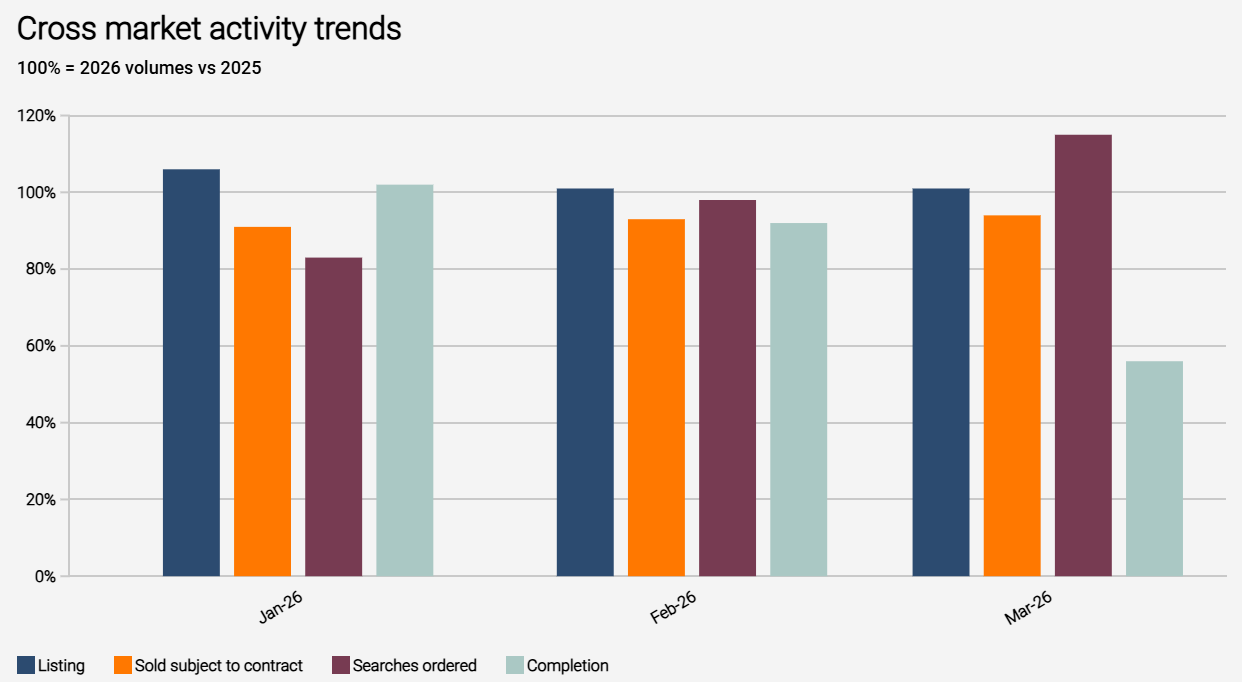
According to the property and land data firm’s Q1 2026 Residential Property Trends Report, listing volumes increased 3% year on year across Q1 2026, recovering from the slowdown in Q4 2025 when many sellers delayed decisions ahead of the Autumn Budget.
January recorded the sharpest rise, with listings up 6% compared with the same period in 2025, leaving stock levels consistently high and giving buyers more choice and negotiating power.
Sold Subject to Contract (SSTC) activity was 8% lower than in Q1 2025, though the comparison was distorted by the surge ahead of the Stamp Duty deadline at the end of March 2025.
The year-on-year gap narrowed from around 25% in November 2025 to 7% by March 2026, with activity rising steadily over that period, suggesting demand is improving but not keeping pace with supply. The report said buyers were moving more selectively and taking longer to progress through transactions.
 Source: Landmark Information Group
Search order volumes averaged 1% lower than Q1 2025, a weaker pattern than typical seasonality for this point in the year. The report linked this to a more deliberate approach by buyers, influenced by cost-of-living pressures and expectations of interest rate increases.
Mortgage valuation activity rose 6% year on year in Q1 2026, driven mainly by remortgaging rather than purchases. In February, remortgage offers were up 28% compared with 2025 levels, while purchase offers fell 4%, highlighting the differing behaviour of existing homeowners and prospective buyers amid wider economic uncertainty.
Completed transactions returned to more typical levels following a spike in March 2025, when completions were 71% higher year on year as buyers rushed to finish ahead of SDLT changes.
Scotland continued to show greater resilience, supported by a more balanced relationship between supply and demand and a transaction process that enables a higher proportion of agreed sales to reach completion.
 “The data points to a market that is showing resilience, but where global pressures and affordability constraints continue to shape how and when people move,” said Simon Brown (pictured right), chief executive of Landmark Information Group.
“Activity is building, but not converting at pace, with steady movement at the early stages of the transaction process not consistently translating through to completion yet.
“If we are to unlock the full potential of the housing market, improving the speed, certainty and transparency of the transaction process must remain a priority. By reducing delays and modernising how the system operates, we can better support buyers and sellers, strengthen confidence, and enable the market to function more efficiently in all conditions, delivering the positive economic impact associated with it.”
Want to be regularly updated with mortgage news and features? Get exclusive interviews, breaking news, and industry events in your inbox – subscribe to our FREE daily newsletter. You can also follow us on Facebook, X (formerly Twitter), and LinkedIn.


