Rents keep rising while lenders and landlords turn cautious

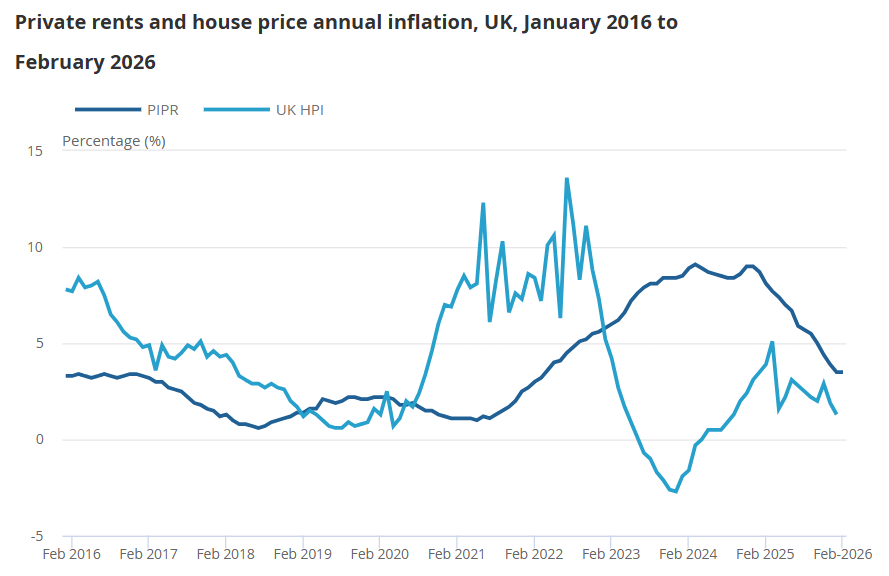
House prices in the UK rose 1.3% in the year to January 2026, taking the average value to £268,000, latest figures from the Office for National Statistics (ONS) showed.
The annual rate was lower than the 1.9% recorded in the year to December 2025.
 Source: Office for National Statistics
England’s average price stood at £290,000 in January 2026, up 1.1% (£3,000) on the year, easing from 1.4% growth in the prior 12-month period. Wales recorded an average of £210,000, up 2.0% (£4,000) year on year, slowing from 4.5% in the year to December 2025.
Scotland’s average reached £188,000, a 1.3% (£3,000) annual rise, down from 3.6% previously. Northern Ireland, measured quarterly, showed stronger momentum. Average prices were £196,000 in Q4 2025 (October to December), up 7.5% (£14,000) from Q4 2024.
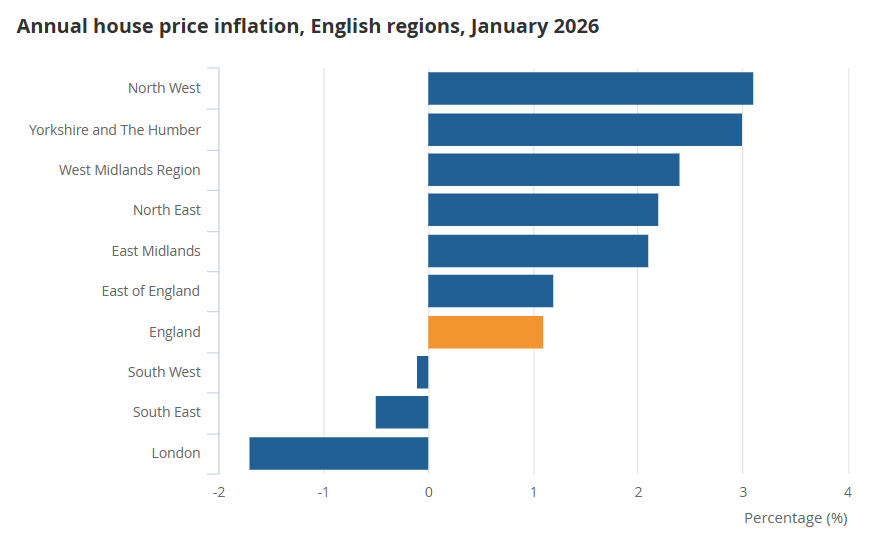
Within England, the North West posted the fastest annual inflation at 3.1% in the year to January 2026, down from 4.0% in the year to December 2025. London recorded the weakest performance, with prices falling 1.7% over the year, compared with a 1.2% decline in the preceding period. It was the sixth straight month of annual falls in the capital.
 Source: Office for National Statistics
 “The property market continues to demonstrate resilience despite a backdrop of global uncertainty,” said Amy Reynolds (pictured right), head of sales at Richmond estate agency Antony Roberts. “The Middle East conflict has contributed to increased caution across financial markets.
“Mortgage rates have already edged upwards in response, and this is naturally becoming a talking point among applicants. We are seeing a slight softening in viewing numbers as some buyers pause to assess the situation; however, the underlying market remains robust.
“Serious buyers are still very much active, with second viewings continuing and sales being agreed at levels typical for this time of year. While there is greater awareness of cost, for the right property, committed buyers are continuing to move forward with confidence.”
Meanwhile, rental growth remained steady, with average UK private rents up 3.5% in the year to February 2026 to £1,374, also based on provisional estimates. This pace matched the annual rate in the year to January 2026.
England’s average rent increased to £1,430, up 3.6% over the year. Wales rose to £828, up 5.5%, and Scotland to £1,022, up 2.4%. In Northern Ireland, the latest figures showed average rents of £875 in the year to December 2025, an increase of 5.2%.
In England, the North East recorded the highest annual rent inflation at 7.6% in the year to February 2026, while London recorded the lowest at 1.7% over the same period.
 “Landlords are navigating a rental market where supply remains constrained and confidence is under pressure,” said Alex Upton (pictured right), managing director of specialist mortgages and bridging finance at Hampshire Trust Bank. “Demand continues to outstrip available stock in many areas, but the more meaningful shift is in how investors are responding to a more complex and less predictable operating environment.
“We are starting to see lenders become more selective, and in some cases step back from parts of the market. That matters. When funding options narrow at the same time as regulatory and cost pressures increase, it creates a more challenging landscape for brokers and landlords to operate within.”
“In this environment, consistency and clarity are not optional. Where funding remains accessible, decision making is clear and lenders continue to engage with complexity, confidence holds. Where it does not, it falls away quickly. That is where the real risk sits. Without stability, pressure in the rental market does not ease, it builds.”
Want to be regularly updated with mortgage news and features? Get exclusive interviews, breaking news, and industry events in your inbox – subscribe to our FREE daily newsletter. You can also follow us on Facebook, X (formerly Twitter), and LinkedIn.